Thursday, November 4, 2010

RABBI ARTHUR SEGAL: JEWISH SPIRITUAL RENEWAL: DEREK ERETZ ZUTA: ENDEARED TO ALL

RABBI ARTHUR SEGAL: JEWISH SPIRITUAL RENEWAL: DEREK ERETZ ZUTA: ENDEARED TO ALL 
 
Jewish Spiritual Renewal: Derek Eretz Zuta + Rabbah: Shabbat 11/06/10
(aka Derech Eretz)
 
The JEWISH SPIRITUAL RENEWAL class list is hosted by Shamash: The Jewish Network a service of Hebrew College/Yeshiva

 
Shalom my dear Chaverim, Talmidim, v' Rabbanim:
 
We continue with our exploration into the Talmudic Tractates of Derek Eretz Zuta and Rabbah. (aka Derech Eretz Zuta, aka Derech Eretz Rabbah), For those new to the class, Baruch ha Ba! Welcome! You can access last week's class  at
 
 
So. together we continue:

TALMUD BAVLI TRACTATE DEREK

ERETZ ZUTA.

(aka Derech Eretz)

CHAPTER I.

1. The qualities of the sages are: Modesty, meekness, eagerness, courage,  bearing wrongs done to them,and being endeared to every one; submission to the members of their household, fear of sin, and judging every one according to his deeds.

In our last classes, we discussed Modesty , Humility,  Meekness, Eagerness , Courage and Bearing Wrongs Done To Us.  Today I invite you to explore with me the middah,  trait,  of  being endeared to every one.

What exactly are the authors of Derek Eretz Zuta (aka Derech Eretz Zuta) meaning when they teach us to be endearing to every one? Well first, we do not need to parse the words ''every one.'' This means what it says, to every human being we encounter.

 But what does being endeared mean? It means that we find in every person something 'dear,' something valuable. When we are spiritually connected we know that  all of us are made from the same Divine sparks. We are all interconnected. We understand that when we hurt another person, we only hurt ourselves. This is why were are taught that all of Torah, including Talmud, is to bring us to ahavath chesed, loving kindness to all. And further, that Derek Eretz, the correct way to treat others, precedes Torah's rituals.

All of us have the breath of life from God blown into us, with the Divine YaH WeH.

"Two eyes were given to man: One with which to see his fellow man's virtues, and another with which to see his own faults, " taught Rebbe Meir of Premishlan . It is so very important for each of us to see the beauty in every person and not see their imperfections. It is also so very important to point out to all their particular beauty. Faults we are to only see within ourselves.
 
As we learned in our class on Jewish Spiritual Renewal : A Path of Mussar Transformation for the Modern Jew,  we are to take our own daily chesbon ha nefesh, inventory of our soul. Never are we to take another's chesbon or inventory. We are to live with 'How do I love thee, let me count the ways." We are not to live with 'How do I find you disgusting, let me count the ways.''
 
As we learned from our studies, the Talmud teaches us that when we find some trait in a person that we do not like, most likely we are projecting on to that person a defect of character of our own, that we won't work on removing in ourselves. It always seems to be the gossip who says that ''so and so talks too much.''
 
"Every person contains something precious that cannot be found in anyone else," opined Rebbe Pinchas of Koretz . That "something precious,'' is what we find endearing. If we do not see it right away, our job is to mine for it, as we would for a precious gemstone.
 
Our society moves at a break neck speed. Yet it has been posited by a modern halachic (Jewish Law) rabbi that just as one must answer all verbal ''hellos'' and ''shaloms'' and ''hand shakes, '' with a ''smile,'' so too must we answer all emails. Now I get tons of emails. Many are forwards, prayer wheels, jokes, political ads, etc. I while I admit I don't read the jokes, the prayer wheels, etc, every email at least gets a response of 'Thank you. How are you? Shalom.'' Now I am referring to folks I know, not the 20 West Africans who daily want me to send $50,000 so they can send me an inheritance from a long lost 6th cousin, who died from a snake bite in Lagos. Lol.
 
In point of fact, with these meshugah   (Yiddish for crazy) social networks, modern Derek Eretz advises us that whomever asks us to ''befriend'' them, we say ''yes.'' Imagine the feelings hurt of someone who asks you to befriend them, and you ignore them? If they become too chatty, every network  allows you to block their wall writings from coming to you. So why loose an opportunity to shine some love and happiness into someone's lives?
 
Everyone has his share of "not good". For those of us in our last class that ended circa Selicoth 2010, we learned this when we did our moral inventories, our chesbons. It's impossible that a physical being should be void of faults. The point is not to flee or hide from them. Nor is it to resign ourselves to it all. It is to face up to the fact that they are there, and to systematically chase them away.

Recognizing who we are and gradually cleaning up our acts is our jobs. It is not to look at others and see their faults.  The mirror may look ugly at first, but it is our Divine path.
 
Let me end this week's class with this thought. As we move through Derek Eretz Zuta and Derek Eretz Rabbah (aka Derech Eretz Zuta and Rabbah), you will see very little about rules about humans relationships with the Divine. The talmidim (disciples) of Rabbi Schneur Zalman of Liadi once asked him: ''Which is greater -- to love God, or to love one's fellow ?'' Replied the Rebbe: ''The love of God and the love of a fellow are equally ingrained in the soul. God loves every person. So to love a fellow is to love what God loves, which is greater than to love Him Himself.'' Remember the Rabbis call us hypocrites and liars, if we say the  V' Ahavtah prayer which announces our loving God, Whom we cannot see, but then ignore or treat badly, a person, who is the image of God, whom we can see.
These are the lessons Derek Eretz Zuta 1:1 is trying to teach us when it is written: being endeared to every one.

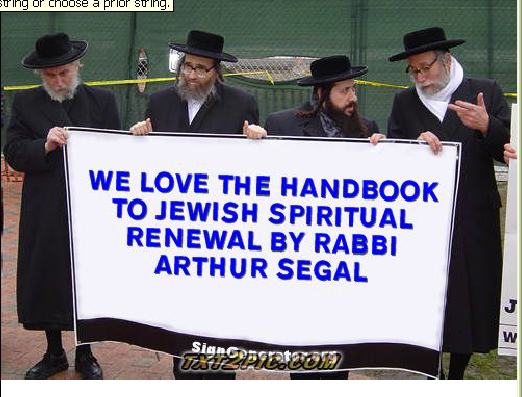
We discuss exactly how to truly love our fellows and find each endearing through out all chapters in   The Handbook to Jewish Spiritual Renewal: A Path of Transformation for the Modern Jew  as well as in most chapters of A Spiritual and Ethical Compendium to the Torah and Talmud  .

What are your ideas about being endeared to everyone ? How does living a life filled with love for all play a role in your spiritual life? How have you combated your desire to withhold love and friendship from someone?
 
Next week, Baruch ha Shem, we will continue with Derek Eretz Zuta, 1:1. [Derech Eretz Zuta]
For those who want a d'var Torah on Parasha Toledot from 
 
 
Shabbat Shalom:
Rabbi Arthur Segal www.jewishspiritualrenewal.org
Via Shamash Org on-line class service
Jewish Renewal www.jewishrenewal.info
Jewish Spiritual Renewal
Jewish Spirituality
Eco Judaism
Hilton Head Island, SC, Bluffton, SC, Savannah, GA
If visiting SC's Low Country, contact us for a Shabbat meal, in our home by the sea, our beth yam.
Maker of Shalom (Oseh Shalom) help make us deserving of Shalom beyond all human comprehension!


The SPIRITUALRENEWAL mailing list is hosted by Shamash: The Jewish Network.
Join Shamash's Groups on Facebook and LinkedIn.


To unsubscribe from the SPIRITUALRENEWAL list, email: SPIRITUALRENEWAL-unsubscribe-request@SHAMASH.ORG
For other options go to: http://listserv.SHAMASH.ORG

RABBI ARTHUR SEGAL: JEWISH LIFE CYCLE EVENTS : CO-OFFICIATE: HILTON HEAD , SC

 
RABBI ARTHUR SEGAL: JEWISH LIFE CYCLE EVENTS : CO-OFFICIATE: HILTON HEAD   , SC
Jewish Spiritual Renewal: Derek Eretz Zuta + Rabbah: Shabbat 11/06/10
(aka Derech Eretz)
 
The JEWISH SPIRITUAL RENEWAL class list is hosted by Shamash: The Jewish Network a service of Hebrew College/Yeshiva

 
Shalom my dear Chaverim, Talmidim, v' Rabbanim:
 
We continue with our exploration into the Talmudic Tractates of Derek Eretz Zuta and Rabbah. (aka Derech Eretz Zuta, aka Derech Eretz Rabbah), For those new to the class, Baruch ha Ba! Welcome! You can access last week's class  at
 
 
So. together we continue:

TALMUD BAVLI TRACTATE DEREK

ERETZ ZUTA.

(aka Derech Eretz)

CHAPTER I.

1. The qualities of the sages are: Modesty, meekness, eagerness, courage,  bearing wrongs done to them,and being endeared to every one; submission to the members of their household, fear of sin, and judging every one according to his deeds.

In our last classes, we discussed Modesty , Humility,  Meekness, Eagerness , Courage and Bearing Wrongs Done To Us.  Today I invite you to explore with me the middah,  trait,  of  being endeared to every one.

What exactly are the authors of Derek Eretz Zuta (aka Derech Eretz Zuta) meaning when they teach us to be endearing to every one? Well first, we do not need to parse the words ''every one.'' This means what it says, to every human being we encounter.

 But what does being endeared mean? It means that we find in every person something 'dear,' something valuable. When we are spiritually connected we know that  all of us are made from the same Divine sparks. We are all interconnected. We understand that when we hurt another person, we only hurt ourselves. This is why were are taught that all of Torah, including Talmud, is to bring us to ahavath chesed, loving kindness to all. And further, that Derek Eretz, the correct way to treat others, precedes Torah's rituals.

All of us have the breath of life from God blown into us, with the Divine YaH WeH.

"Two eyes were given to man: One with which to see his fellow man's virtues, and another with which to see his own faults, " taught Rebbe Meir of Premishlan . It is so very important for each of us to see the beauty in every person and not see their imperfections. It is also so very important to point out to all their particular beauty. Faults we are to only see within ourselves.
 
As we learned in our class on Jewish Spiritual Renewal : A Path of Mussar Transformation for the Modern Jew,  we are to take our own daily chesbon ha nefesh, inventory of our soul. Never are we to take another's chesbon or inventory. We are to live with 'How do I love thee, let me count the ways." We are not to live with 'How do I find you disgusting, let me count the ways.''
 
As we learned from our studies, the Talmud teaches us that when we find some trait in a person that we do not like, most likely we are projecting on to that person a defect of character of our own, that we won't work on removing in ourselves. It always seems to be the gossip who says that ''so and so talks too much.''
 
"Every person contains something precious that cannot be found in anyone else," opined Rebbe Pinchas of Koretz . That "something precious,'' is what we find endearing. If we do not see it right away, our job is to mine for it, as we would for a precious gemstone.
 
Our society moves at a break neck speed. Yet it has been posited by a modern halachic (Jewish Law) rabbi that just as one must answer all verbal ''hellos'' and ''shaloms'' and ''hand shakes, '' with a ''smile,'' so too must we answer all emails. Now I get tons of emails. Many are forwards, prayer wheels, jokes, political ads, etc. I while I admit I don't read the jokes, the prayer wheels, etc, every email at least gets a response of 'Thank you. How are you? Shalom.'' Now I am referring to folks I know, not the 20 West Africans who daily want me to send $50,000 so they can send me an inheritance from a long lost 6th cousin, who died from a snake bite in Lagos. Lol.
 
In point of fact, with these meshugah   (Yiddish for crazy) social networks, modern Derek Eretz advises us that whomever asks us to ''befriend'' them, we say ''yes.'' Imagine the feelings hurt of someone who asks you to befriend them, and you ignore them? If they become too chatty, every network  allows you to block their wall writings from coming to you. So why loose an opportunity to shine some love and happiness into someone's lives?
 
Everyone has his share of "not good". For those of us in our last class that ended circa Selicoth 2010, we learned this when we did our moral inventories, our chesbons. It's impossible that a physical being should be void of faults. The point is not to flee or hide from them. Nor is it to resign ourselves to it all. It is to face up to the fact that they are there, and to systematically chase them away.

Recognizing who we are and gradually cleaning up our acts is our jobs. It is not to look at others and see their faults.  The mirror may look ugly at first, but it is our Divine path.
 
Let me end this week's class with this thought. As we move through Derek Eretz Zuta and Derek Eretz Rabbah (aka Derech Eretz Zuta and Rabbah), you will see very little about rules about humans relationships with the Divine. The talmidim (disciples) of Rabbi Schneur Zalman of Liadi once asked him: ''Which is greater -- to love God, or to love one's fellow ?'' Replied the Rebbe: ''The love of God and the love of a fellow are equally ingrained in the soul. God loves every person. So to love a fellow is to love what God loves, which is greater than to love Him Himself.'' Remember the Rabbis call us hypocrites and liars, if we say the  V' Ahavtah prayer which announces our loving God, Whom we cannot see, but then ignore or treat badly, a person, who is the image of God, whom we can see.
These are the lessons Derek Eretz Zuta 1:1 is trying to teach us when it is written: being endeared to every one.

We discuss exactly how to truly love our fellows and find each endearing through out all chapters in   The Handbook to Jewish Spiritual Renewal: A Path of Transformation for the Modern Jew  as well as in most chapters of A Spiritual and Ethical Compendium to the Torah and Talmud  .

What are your ideas about being endeared to everyone ? How does living a life filled with love for all play a role in your spiritual life? How have you combated your desire to withhold love and friendship from someone?
 
Next week, Baruch ha Shem, we will continue with Derek Eretz Zuta, 1:1. [Derech Eretz Zuta]
For those who want a d'var Torah on Parasha Toledot from 
 
 
Shabbat Shalom:
Rabbi Arthur Segal www.jewishspiritualrenewal.org
Via Shamash Org on-line class service
Jewish Renewal www.jewishrenewal.info
Jewish Spiritual Renewal
Jewish Spirituality
Eco Judaism
Hilton Head Island, SC, Bluffton, SC, Savannah, GA
If visiting SC's Low Country, contact us for a Shabbat meal, in our home by the sea, our beth yam.
Maker of Shalom (Oseh Shalom) help make us deserving of Shalom beyond all human comprehension!


The SPIRITUALRENEWAL mailing list is hosted by Shamash: The Jewish Network.
Join Shamash's Groups on Facebook and LinkedIn.


To unsubscribe from the SPIRITUALRENEWAL list, email: SPIRITUALRENEWAL-unsubscribe-request@SHAMASH.ORG
For other options go to: http://listserv.SHAMASH.ORG

RABBI ARTHUR SEGAL: JEWISH LIFE CYCLE EVENTS : CO-OFFICIATE: BLUFFTON , SC

 
RABBI ARTHUR SEGAL: JEWISH LIFE CYCLE EVENTS : CO-OFFICIATE:  BLUFFTON , SC
Jewish Spiritual Renewal: Derek Eretz Zuta + Rabbah: Shabbat 11/06/10
(aka Derech Eretz)
 
The JEWISH SPIRITUAL RENEWAL class list is hosted by Shamash: The Jewish Network a service of Hebrew College/Yeshiva

 
Shalom my dear Chaverim, Talmidim, v' Rabbanim:
 
We continue with our exploration into the Talmudic Tractates of Derek Eretz Zuta and Rabbah. (aka Derech Eretz Zuta, aka Derech Eretz Rabbah), For those new to the class, Baruch ha Ba! Welcome! You can access last week's class  at
 
 
So. together we continue:

TALMUD BAVLI TRACTATE DEREK

ERETZ ZUTA.

(aka Derech Eretz)

CHAPTER I.

1. The qualities of the sages are: Modesty, meekness, eagerness, courage,  bearing wrongs done to them,and being endeared to every one; submission to the members of their household, fear of sin, and judging every one according to his deeds.

In our last classes, we discussed Modesty , Humility,  Meekness, Eagerness , Courage and Bearing Wrongs Done To Us.  Today I invite you to explore with me the middah,  trait,  of  being endeared to every one.

What exactly are the authors of Derek Eretz Zuta (aka Derech Eretz Zuta) meaning when they teach us to be endearing to every one? Well first, we do not need to parse the words ''every one.'' This means what it says, to every human being we encounter.

 But what does being endeared mean? It means that we find in every person something 'dear,' something valuable. When we are spiritually connected we know that  all of us are made from the same Divine sparks. We are all interconnected. We understand that when we hurt another person, we only hurt ourselves. This is why were are taught that all of Torah, including Talmud, is to bring us to ahavath chesed, loving kindness to all. And further, that Derek Eretz, the correct way to treat others, precedes Torah's rituals.

All of us have the breath of life from God blown into us, with the Divine YaH WeH.

"Two eyes were given to man: One with which to see his fellow man's virtues, and another with which to see his own faults, " taught Rebbe Meir of Premishlan . It is so very important for each of us to see the beauty in every person and not see their imperfections. It is also so very important to point out to all their particular beauty. Faults we are to only see within ourselves.
 
As we learned in our class on Jewish Spiritual Renewal : A Path of Mussar Transformation for the Modern Jew,  we are to take our own daily chesbon ha nefesh, inventory of our soul. Never are we to take another's chesbon or inventory. We are to live with 'How do I love thee, let me count the ways." We are not to live with 'How do I find you disgusting, let me count the ways.''
 
As we learned from our studies, the Talmud teaches us that when we find some trait in a person that we do not like, most likely we are projecting on to that person a defect of character of our own, that we won't work on removing in ourselves. It always seems to be the gossip who says that ''so and so talks too much.''
 
"Every person contains something precious that cannot be found in anyone else," opined Rebbe Pinchas of Koretz . That "something precious,'' is what we find endearing. If we do not see it right away, our job is to mine for it, as we would for a precious gemstone.
 
Our society moves at a break neck speed. Yet it has been posited by a modern halachic (Jewish Law) rabbi that just as one must answer all verbal ''hellos'' and ''shaloms'' and ''hand shakes, '' with a ''smile,'' so too must we answer all emails. Now I get tons of emails. Many are forwards, prayer wheels, jokes, political ads, etc. I while I admit I don't read the jokes, the prayer wheels, etc, every email at least gets a response of 'Thank you. How are you? Shalom.'' Now I am referring to folks I know, not the 20 West Africans who daily want me to send $50,000 so they can send me an inheritance from a long lost 6th cousin, who died from a snake bite in Lagos. Lol.
 
In point of fact, with these meshugah   (Yiddish for crazy) social networks, modern Derek Eretz advises us that whomever asks us to ''befriend'' them, we say ''yes.'' Imagine the feelings hurt of someone who asks you to befriend them, and you ignore them? If they become too chatty, every network  allows you to block their wall writings from coming to you. So why loose an opportunity to shine some love and happiness into someone's lives?
 
Everyone has his share of "not good". For those of us in our last class that ended circa Selicoth 2010, we learned this when we did our moral inventories, our chesbons. It's impossible that a physical being should be void of faults. The point is not to flee or hide from them. Nor is it to resign ourselves to it all. It is to face up to the fact that they are there, and to systematically chase them away.

Recognizing who we are and gradually cleaning up our acts is our jobs. It is not to look at others and see their faults.  The mirror may look ugly at first, but it is our Divine path.
 
Let me end this week's class with this thought. As we move through Derek Eretz Zuta and Derek Eretz Rabbah (aka Derech Eretz Zuta and Rabbah), you will see very little about rules about humans relationships with the Divine. The talmidim (disciples) of Rabbi Schneur Zalman of Liadi once asked him: ''Which is greater -- to love God, or to love one's fellow ?'' Replied the Rebbe: ''The love of God and the love of a fellow are equally ingrained in the soul. God loves every person. So to love a fellow is to love what God loves, which is greater than to love Him Himself.'' Remember the Rabbis call us hypocrites and liars, if we say the  V' Ahavtah prayer which announces our loving God, Whom we cannot see, but then ignore or treat badly, a person, who is the image of God, whom we can see.
These are the lessons Derek Eretz Zuta 1:1 is trying to teach us when it is written: being endeared to every one.

We discuss exactly how to truly love our fellows and find each endearing through out all chapters in   The Handbook to Jewish Spiritual Renewal: A Path of Transformation for the Modern Jew  as well as in most chapters of A Spiritual and Ethical Compendium to the Torah and Talmud  .

What are your ideas about being endeared to everyone ? How does living a life filled with love for all play a role in your spiritual life? How have you combated your desire to withhold love and friendship from someone?
 
Next week, Baruch ha Shem, we will continue with Derek Eretz Zuta, 1:1. [Derech Eretz Zuta]
For those who want a d'var Torah on Parasha Toledot from 
 
 
Shabbat Shalom:
Rabbi Arthur Segal www.jewishspiritualrenewal.org
Via Shamash Org on-line class service
Jewish Renewal www.jewishrenewal.info
Jewish Spiritual Renewal
Jewish Spirituality
Eco Judaism
Hilton Head Island, SC, Bluffton, SC, Savannah, GA
If visiting SC's Low Country, contact us for a Shabbat meal, in our home by the sea, our beth yam.
Maker of Shalom (Oseh Shalom) help make us deserving of Shalom beyond all human comprehension!


The SPIRITUALRENEWAL mailing list is hosted by Shamash: The Jewish Network.
Join Shamash's Groups on Facebook and LinkedIn.


To unsubscribe from the SPIRITUALRENEWAL list, email: SPIRITUALRENEWAL-unsubscribe-request@SHAMASH.ORG
For other options go to: http://listserv.SHAMASH.ORG

RABBI ARTHUR SEGAL: JEWISH DESTINATION WEDDINGS: CO-OFFICIATE: HILTON HEAD, SC

 
RABBI ARTHUR SEGAL: JEWISH DESTINATION WEDDINGS: CO-OFFICIATE: HILTON HEAD, SC
Jewish Spiritual Renewal: Derek Eretz Zuta + Rabbah: Shabbat 11/06/10
(aka Derech Eretz)
 
The JEWISH SPIRITUAL RENEWAL class list is hosted by Shamash: The Jewish Network a service of Hebrew College/Yeshiva

 
Shalom my dear Chaverim, Talmidim, v' Rabbanim:
 
We continue with our exploration into the Talmudic Tractates of Derek Eretz Zuta and Rabbah. (aka Derech Eretz Zuta, aka Derech Eretz Rabbah), For those new to the class, Baruch ha Ba! Welcome! You can access last week's class  at
 
 
So. together we continue:

TALMUD BAVLI TRACTATE DEREK

ERETZ ZUTA.

(aka Derech Eretz)

CHAPTER I.

1. The qualities of the sages are: Modesty, meekness, eagerness, courage,  bearing wrongs done to them,and being endeared to every one; submission to the members of their household, fear of sin, and judging every one according to his deeds.

In our last classes, we discussed Modesty , Humility,  Meekness, Eagerness , Courage and Bearing Wrongs Done To Us.  Today I invite you to explore with me the middah,  trait,  of  being endeared to every one.

What exactly are the authors of Derek Eretz Zuta (aka Derech Eretz Zuta) meaning when they teach us to be endearing to every one? Well first, we do not need to parse the words ''every one.'' This means what it says, to every human being we encounter.

 But what does being endeared mean? It means that we find in every person something 'dear,' something valuable. When we are spiritually connected we know that  all of us are made from the same Divine sparks. We are all interconnected. We understand that when we hurt another person, we only hurt ourselves. This is why were are taught that all of Torah, including Talmud, is to bring us to ahavath chesed, loving kindness to all. And further, that Derek Eretz, the correct way to treat others, precedes Torah's rituals.

All of us have the breath of life from God blown into us, with the Divine YaH WeH.

"Two eyes were given to man: One with which to see his fellow man's virtues, and another with which to see his own faults, " taught Rebbe Meir of Premishlan . It is so very important for each of us to see the beauty in every person and not see their imperfections. It is also so very important to point out to all their particular beauty. Faults we are to only see within ourselves.
 
As we learned in our class on Jewish Spiritual Renewal : A Path of Mussar Transformation for the Modern Jew,  we are to take our own daily chesbon ha nefesh, inventory of our soul. Never are we to take another's chesbon or inventory. We are to live with 'How do I love thee, let me count the ways." We are not to live with 'How do I find you disgusting, let me count the ways.''
 
As we learned from our studies, the Talmud teaches us that when we find some trait in a person that we do not like, most likely we are projecting on to that person a defect of character of our own, that we won't work on removing in ourselves. It always seems to be the gossip who says that ''so and so talks too much.''
 
"Every person contains something precious that cannot be found in anyone else," opined Rebbe Pinchas of Koretz . That "something precious,'' is what we find endearing. If we do not see it right away, our job is to mine for it, as we would for a precious gemstone.
 
Our society moves at a break neck speed. Yet it has been posited by a modern halachic (Jewish Law) rabbi that just as one must answer all verbal ''hellos'' and ''shaloms'' and ''hand shakes, '' with a ''smile,'' so too must we answer all emails. Now I get tons of emails. Many are forwards, prayer wheels, jokes, political ads, etc. I while I admit I don't read the jokes, the prayer wheels, etc, every email at least gets a response of 'Thank you. How are you? Shalom.'' Now I am referring to folks I know, not the 20 West Africans who daily want me to send $50,000 so they can send me an inheritance from a long lost 6th cousin, who died from a snake bite in Lagos. Lol.
 
In point of fact, with these meshugah   (Yiddish for crazy) social networks, modern Derek Eretz advises us that whomever asks us to ''befriend'' them, we say ''yes.'' Imagine the feelings hurt of someone who asks you to befriend them, and you ignore them? If they become too chatty, every network  allows you to block their wall writings from coming to you. So why loose an opportunity to shine some love and happiness into someone's lives?
 
Everyone has his share of "not good". For those of us in our last class that ended circa Selicoth 2010, we learned this when we did our moral inventories, our chesbons. It's impossible that a physical being should be void of faults. The point is not to flee or hide from them. Nor is it to resign ourselves to it all. It is to face up to the fact that they are there, and to systematically chase them away.

Recognizing who we are and gradually cleaning up our acts is our jobs. It is not to look at others and see their faults.  The mirror may look ugly at first, but it is our Divine path.
 
Let me end this week's class with this thought. As we move through Derek Eretz Zuta and Derek Eretz Rabbah (aka Derech Eretz Zuta and Rabbah), you will see very little about rules about humans relationships with the Divine. The talmidim (disciples) of Rabbi Schneur Zalman of Liadi once asked him: ''Which is greater -- to love God, or to love one's fellow ?'' Replied the Rebbe: ''The love of God and the love of a fellow are equally ingrained in the soul. God loves every person. So to love a fellow is to love what God loves, which is greater than to love Him Himself.'' Remember the Rabbis call us hypocrites and liars, if we say the  V' Ahavtah prayer which announces our loving God, Whom we cannot see, but then ignore or treat badly, a person, who is the image of God, whom we can see.
These are the lessons Derek Eretz Zuta 1:1 is trying to teach us when it is written: being endeared to every one.

We discuss exactly how to truly love our fellows and find each endearing through out all chapters in   The Handbook to Jewish Spiritual Renewal: A Path of Transformation for the Modern Jew  as well as in most chapters of A Spiritual and Ethical Compendium to the Torah and Talmud  .

What are your ideas about being endeared to everyone ? How does living a life filled with love for all play a role in your spiritual life? How have you combated your desire to withhold love and friendship from someone?
 
Next week, Baruch ha Shem, we will continue with Derek Eretz Zuta, 1:1. [Derech Eretz Zuta]
For those who want a d'var Torah on Parasha Toledot from 
 
 
Shabbat Shalom:
Rabbi Arthur Segal www.jewishspiritualrenewal.org
Via Shamash Org on-line class service
Jewish Renewal www.jewishrenewal.info
Jewish Spiritual Renewal
Jewish Spirituality
Eco Judaism
Hilton Head Island, SC, Bluffton, SC, Savannah, GA
If visiting SC's Low Country, contact us for a Shabbat meal, in our home by the sea, our beth yam.
Maker of Shalom (Oseh Shalom) help make us deserving of Shalom beyond all human comprehension!


The SPIRITUALRENEWAL mailing list is hosted by Shamash: The Jewish Network.
Join Shamash's Groups on Facebook and LinkedIn.


To unsubscribe from the SPIRITUALRENEWAL list, email: SPIRITUALRENEWAL-unsubscribe-request@SHAMASH.ORG
For other options go to: http://listserv.SHAMASH.ORG

RABBI ARTHUR SEGAL: JEWISH DESTINATION WEDDINGS: CO-OFFICIATE: BLUFFTON , SC

 
RABBI ARTHUR SEGAL: JEWISH DESTINATION WEDDINGS: CO-OFFICIATE:  BLUFFTON , SC
Jewish Spiritual Renewal: Derek Eretz Zuta + Rabbah: Shabbat 11/06/10
(aka Derech Eretz)
 
The JEWISH SPIRITUAL RENEWAL class list is hosted by Shamash: The Jewish Network a service of Hebrew College/Yeshiva

 
Shalom my dear Chaverim, Talmidim, v' Rabbanim:
 
We continue with our exploration into the Talmudic Tractates of Derek Eretz Zuta and Rabbah. (aka Derech Eretz Zuta, aka Derech Eretz Rabbah), For those new to the class, Baruch ha Ba! Welcome! You can access last week's class  at
 
 
So. together we continue:

TALMUD BAVLI TRACTATE DEREK

ERETZ ZUTA.

(aka Derech Eretz)

CHAPTER I.

1. The qualities of the sages are: Modesty, meekness, eagerness, courage,  bearing wrongs done to them,and being endeared to every one; submission to the members of their household, fear of sin, and judging every one according to his deeds.

In our last classes, we discussed Modesty , Humility,  Meekness, Eagerness , Courage and Bearing Wrongs Done To Us.  Today I invite you to explore with me the middah,  trait,  of  being endeared to every one.

What exactly are the authors of Derek Eretz Zuta (aka Derech Eretz Zuta) meaning when they teach us to be endearing to every one? Well first, we do not need to parse the words ''every one.'' This means what it says, to every human being we encounter.

 But what does being endeared mean? It means that we find in every person something 'dear,' something valuable. When we are spiritually connected we know that  all of us are made from the same Divine sparks. We are all interconnected. We understand that when we hurt another person, we only hurt ourselves. This is why were are taught that all of Torah, including Talmud, is to bring us to ahavath chesed, loving kindness to all. And further, that Derek Eretz, the correct way to treat others, precedes Torah's rituals.

All of us have the breath of life from God blown into us, with the Divine YaH WeH.

"Two eyes were given to man: One with which to see his fellow man's virtues, and another with which to see his own faults, " taught Rebbe Meir of Premishlan . It is so very important for each of us to see the beauty in every person and not see their imperfections. It is also so very important to point out to all their particular beauty. Faults we are to only see within ourselves.
 
As we learned in our class on Jewish Spiritual Renewal : A Path of Mussar Transformation for the Modern Jew,  we are to take our own daily chesbon ha nefesh, inventory of our soul. Never are we to take another's chesbon or inventory. We are to live with 'How do I love thee, let me count the ways." We are not to live with 'How do I find you disgusting, let me count the ways.''
 
As we learned from our studies, the Talmud teaches us that when we find some trait in a person that we do not like, most likely we are projecting on to that person a defect of character of our own, that we won't work on removing in ourselves. It always seems to be the gossip who says that ''so and so talks too much.''
 
"Every person contains something precious that cannot be found in anyone else," opined Rebbe Pinchas of Koretz . That "something precious,'' is what we find endearing. If we do not see it right away, our job is to mine for it, as we would for a precious gemstone.
 
Our society moves at a break neck speed. Yet it has been posited by a modern halachic (Jewish Law) rabbi that just as one must answer all verbal ''hellos'' and ''shaloms'' and ''hand shakes, '' with a ''smile,'' so too must we answer all emails. Now I get tons of emails. Many are forwards, prayer wheels, jokes, political ads, etc. I while I admit I don't read the jokes, the prayer wheels, etc, every email at least gets a response of 'Thank you. How are you? Shalom.'' Now I am referring to folks I know, not the 20 West Africans who daily want me to send $50,000 so they can send me an inheritance from a long lost 6th cousin, who died from a snake bite in Lagos. Lol.
 
In point of fact, with these meshugah   (Yiddish for crazy) social networks, modern Derek Eretz advises us that whomever asks us to ''befriend'' them, we say ''yes.'' Imagine the feelings hurt of someone who asks you to befriend them, and you ignore them? If they become too chatty, every network  allows you to block their wall writings from coming to you. So why loose an opportunity to shine some love and happiness into someone's lives?
 
Everyone has his share of "not good". For those of us in our last class that ended circa Selicoth 2010, we learned this when we did our moral inventories, our chesbons. It's impossible that a physical being should be void of faults. The point is not to flee or hide from them. Nor is it to resign ourselves to it all. It is to face up to the fact that they are there, and to systematically chase them away.

Recognizing who we are and gradually cleaning up our acts is our jobs. It is not to look at others and see their faults.  The mirror may look ugly at first, but it is our Divine path.
 
Let me end this week's class with this thought. As we move through Derek Eretz Zuta and Derek Eretz Rabbah (aka Derech Eretz Zuta and Rabbah), you will see very little about rules about humans relationships with the Divine. The talmidim (disciples) of Rabbi Schneur Zalman of Liadi once asked him: ''Which is greater -- to love God, or to love one's fellow ?'' Replied the Rebbe: ''The love of God and the love of a fellow are equally ingrained in the soul. God loves every person. So to love a fellow is to love what God loves, which is greater than to love Him Himself.'' Remember the Rabbis call us hypocrites and liars, if we say the  V' Ahavtah prayer which announces our loving God, Whom we cannot see, but then ignore or treat badly, a person, who is the image of God, whom we can see.
These are the lessons Derek Eretz Zuta 1:1 is trying to teach us when it is written: being endeared to every one.

We discuss exactly how to truly love our fellows and find each endearing through out all chapters in   The Handbook to Jewish Spiritual Renewal: A Path of Transformation for the Modern Jew  as well as in most chapters of A Spiritual and Ethical Compendium to the Torah and Talmud  .

What are your ideas about being endeared to everyone ? How does living a life filled with love for all play a role in your spiritual life? How have you combated your desire to withhold love and friendship from someone?
 
Next week, Baruch ha Shem, we will continue with Derek Eretz Zuta, 1:1. [Derech Eretz Zuta]
For those who want a d'var Torah on Parasha Toledot from 
 
 
Shabbat Shalom:
Rabbi Arthur Segal www.jewishspiritualrenewal.org
Via Shamash Org on-line class service
Jewish Renewal www.jewishrenewal.info
Jewish Spiritual Renewal
Jewish Spirituality
Eco Judaism
Hilton Head Island, SC, Bluffton, SC, Savannah, GA
If visiting SC's Low Country, contact us for a Shabbat meal, in our home by the sea, our beth yam.
Maker of Shalom (Oseh Shalom) help make us deserving of Shalom beyond all human comprehension!


The SPIRITUALRENEWAL mailing list is hosted by Shamash: The Jewish Network.
Join Shamash's Groups on Facebook and LinkedIn.


To unsubscribe from the SPIRITUALRENEWAL list, email: SPIRITUALRENEWAL-unsubscribe-request@SHAMASH.ORG
For other options go to: http://listserv.SHAMASH.ORG

RABBI ARTHUR SEGAL: ECO-JUDAISM: Two eyes were given to man: VIRTUES: FAULTS

 
RABBI ARTHUR SEGAL: ECO-JUDAISM: Two eyes were given to man: VIRTUES: FAULTS
Jewish Spiritual Renewal: Derek Eretz Zuta + Rabbah: Shabbat 11/06/10
(aka Derech Eretz)
 
The JEWISH SPIRITUAL RENEWAL class list is hosted by Shamash: The Jewish Network a service of Hebrew College/Yeshiva

 
Shalom my dear Chaverim, Talmidim, v' Rabbanim:
 
We continue with our exploration into the Talmudic Tractates of Derek Eretz Zuta and Rabbah. (aka Derech Eretz Zuta, aka Derech Eretz Rabbah), For those new to the class, Baruch ha Ba! Welcome! You can access last week's class  at
 
 
So. together we continue:

TALMUD BAVLI TRACTATE DEREK

ERETZ ZUTA.

(aka Derech Eretz)

CHAPTER I.

1. The qualities of the sages are: Modesty, meekness, eagerness, courage,  bearing wrongs done to them,and being endeared to every one; submission to the members of their household, fear of sin, and judging every one according to his deeds.

In our last classes, we discussed Modesty , Humility,  Meekness, Eagerness , Courage and Bearing Wrongs Done To Us.  Today I invite you to explore with me the middah,  trait,  of  being endeared to every one.

What exactly are the authors of Derek Eretz Zuta (aka Derech Eretz Zuta) meaning when they teach us to be endearing to every one? Well first, we do not need to parse the words ''every one.'' This means what it says, to every human being we encounter.

 But what does being endeared mean? It means that we find in every person something 'dear,' something valuable. When we are spiritually connected we know that  all of us are made from the same Divine sparks. We are all interconnected. We understand that when we hurt another person, we only hurt ourselves. This is why were are taught that all of Torah, including Talmud, is to bring us to ahavath chesed, loving kindness to all. And further, that Derek Eretz, the correct way to treat others, precedes Torah's rituals.

All of us have the breath of life from God blown into us, with the Divine YaH WeH.

"Two eyes were given to man: One with which to see his fellow man's virtues, and another with which to see his own faults, " taught Rebbe Meir of Premishlan . It is so very important for each of us to see the beauty in every person and not see their imperfections. It is also so very important to point out to all their particular beauty. Faults we are to only see within ourselves.
 
As we learned in our class on Jewish Spiritual Renewal : A Path of Mussar Transformation for the Modern Jew,  we are to take our own daily chesbon ha nefesh, inventory of our soul. Never are we to take another's chesbon or inventory. We are to live with 'How do I love thee, let me count the ways." We are not to live with 'How do I find you disgusting, let me count the ways.''
 
As we learned from our studies, the Talmud teaches us that when we find some trait in a person that we do not like, most likely we are projecting on to that person a defect of character of our own, that we won't work on removing in ourselves. It always seems to be the gossip who says that ''so and so talks too much.''
 
"Every person contains something precious that cannot be found in anyone else," opined Rebbe Pinchas of Koretz . That "something precious,'' is what we find endearing. If we do not see it right away, our job is to mine for it, as we would for a precious gemstone.
 
Our society moves at a break neck speed. Yet it has been posited by a modern halachic (Jewish Law) rabbi that just as one must answer all verbal ''hellos'' and ''shaloms'' and ''hand shakes, '' with a ''smile,'' so too must we answer all emails. Now I get tons of emails. Many are forwards, prayer wheels, jokes, political ads, etc. I while I admit I don't read the jokes, the prayer wheels, etc, every email at least gets a response of 'Thank you. How are you? Shalom.'' Now I am referring to folks I know, not the 20 West Africans who daily want me to send $50,000 so they can send me an inheritance from a long lost 6th cousin, who died from a snake bite in Lagos. Lol.
 
In point of fact, with these meshugah   (Yiddish for crazy) social networks, modern Derek Eretz advises us that whomever asks us to ''befriend'' them, we say ''yes.'' Imagine the feelings hurt of someone who asks you to befriend them, and you ignore them? If they become too chatty, every network  allows you to block their wall writings from coming to you. So why loose an opportunity to shine some love and happiness into someone's lives?
 
Everyone has his share of "not good". For those of us in our last class that ended circa Selicoth 2010, we learned this when we did our moral inventories, our chesbons. It's impossible that a physical being should be void of faults. The point is not to flee or hide from them. Nor is it to resign ourselves to it all. It is to face up to the fact that they are there, and to systematically chase them away.

Recognizing who we are and gradually cleaning up our acts is our jobs. It is not to look at others and see their faults.  The mirror may look ugly at first, but it is our Divine path.
 
Let me end this week's class with this thought. As we move through Derek Eretz Zuta and Derek Eretz Rabbah (aka Derech Eretz Zuta and Rabbah), you will see very little about rules about humans relationships with the Divine. The talmidim (disciples) of Rabbi Schneur Zalman of Liadi once asked him: ''Which is greater -- to love God, or to love one's fellow ?'' Replied the Rebbe: ''The love of God and the love of a fellow are equally ingrained in the soul. God loves every person. So to love a fellow is to love what God loves, which is greater than to love Him Himself.'' Remember the Rabbis call us hypocrites and liars, if we say the  V' Ahavtah prayer which announces our loving God, Whom we cannot see, but then ignore or treat badly, a person, who is the image of God, whom we can see.
These are the lessons Derek Eretz Zuta 1:1 is trying to teach us when it is written: being endeared to every one.

We discuss exactly how to truly love our fellows and find each endearing through out all chapters in   The Handbook to Jewish Spiritual Renewal: A Path of Transformation for the Modern Jew  as well as in most chapters of A Spiritual and Ethical Compendium to the Torah and Talmud  .

What are your ideas about being endeared to everyone ? How does living a life filled with love for all play a role in your spiritual life? How have you combated your desire to withhold love and friendship from someone?
 
Next week, Baruch ha Shem, we will continue with Derek Eretz Zuta, 1:1. [Derech Eretz Zuta]
For those who want a d'var Torah on Parasha Toledot from 
 
 
Shabbat Shalom:
Rabbi Arthur Segal www.jewishspiritualrenewal.org
Via Shamash Org on-line class service
Jewish Renewal www.jewishrenewal.info
Jewish Spiritual Renewal
Jewish Spirituality
Eco Judaism
Hilton Head Island, SC, Bluffton, SC, Savannah, GA
If visiting SC's Low Country, contact us for a Shabbat meal, in our home by the sea, our beth yam.
Maker of Shalom (Oseh Shalom) help make us deserving of Shalom beyond all human comprehension!


The SPIRITUALRENEWAL mailing list is hosted by Shamash: The Jewish Network.
Join Shamash's Groups on Facebook and LinkedIn.


To unsubscribe from the SPIRITUALRENEWAL list, email: SPIRITUALRENEWAL-unsubscribe-request@SHAMASH.ORG
For other options go to: http://listserv.SHAMASH.ORG

Tuesday, November 2, 2010

RABBI ARTHUR SEGAL: JEWISH SPIRITUAL RENEWAL: kinder, gentler Islam


RABBI ARTHUR SEGAL: JEWISH SPIRITUAL RENEWAL:  kinder, gentler Islam


The thinker that strove to a kinder, gentler Islam

Nasr Hamid Abu Zayd, who died this past summer, leaves behind a body of work that stressed the human, accessible nature of the Koran.

By Israel Schrenzel

In July, Nasr Hamid Abu Zayd, one of the greatest liberal Muslim philosophers of our time, died in Egypt, just short of his 67th birthday. He was known mainly for developing what is called a "humanistic hermeneutics" of Islam. There would be no reason to mention the fact that he died in his homeland had he not been forced into exile during the mid-1990s, after a major public scandal there.

In 1992, when he was a candidate for promotion to full professor in Cairo University, one of the members of the confirmation committee claimed that his writings constituted a clear insult to Islam. An activist in a fundamentalist Islamic organization exploited this view (which was a minority opinion even within the committee itself, which confirmed Abu Zayd's appointment in the end ) and submitted a request to sharia court to annul the scholar's marriage, arguing that his views made him an apostate, and that because of this, his Muslim wife (a professor of French literature at Cairo University ) was not permitted to be married to him.

The Koran

The Koran. A form of discourse.

At first the request was rejected, but it was later approved in an appeals court, in the spirit of the extremism that prevailed at the time - and is still in evidence - with respect to intellectuals and artists suspected of liberal and secular views.

The higher court's ruling aroused a profound public debate and was for the most part perceived as deviating from accepted procedure. At the same time, fundamentalist organizations exploited the ruling and threatened Abu Zayd's life. He and his wife moved to Holland, where he taught at Leiden University, an important center of Middle Eastern studies. There he continued with intensive academic activity, which included writing many books and articles in Arabic and other languages, and he also won a number of prizes and honors from Western organizations, which were happy to be identified with such a "positive" Muslim personality, especially in the wake of September 11, 2001.

In his autobiographical "Voice of an Exile: Reflections on Islam" (Praeger Publishers, 2004 ), Abu Zayd describes his acute homesickness for Egypt, and his dream of being able to return and to teach there once again. He did in fact visit his homeland several times during his exile, keeping a very low profile, but he didn't stay. His description of his first visit is very moving: "As soon as the plane landed, it seemed as though I had left Egypt only the day before .... A customs official asked me, 'Do you have anything to declare?' I simply answered no. He then produced a hint of a smile before saying, 'Welcome back, Professor.' I liked the sound of it" (translation by Esther R. Nelson ).

On the other hand, conservative circles managed to prevent his entry into Kuwait in 2009. After he fell ill during a visit to Indonesia this past summer, he was treated in Egypt, where he died on July 5 at the age of 66. He was buried in his village.

Anyone perusing Abu Zayd's writings will not find a passionate heretic, as his opponents attempted to portray him, and yet it is quite clear why his philosophy was anathema to the religious establishment and to fundamentalist organizations in Egypt and elsewhere. His main activity was the study and interpretation of the Koran. In his youth he learned the sacred book by heart, and for a short period was a member of the Muslim Brotherhood. As his academic career proceeded, though, he developed independent views. He initially focused on relating to the Koran as a text, arguing that the most modern methodology of textual research and exegesis should be applied to it, in the spirit of the disciplines of linguistics, hermeneutics and semiotics.

He later took a more dramatic step (under the influence of Russian-Jewish semioticist Yuri Lotman ), and suggested that the Koran first and foremost constituted a form of oral discourse and communication between a divine source - whose existence he never denied - and its "recipient," the prophet Mohammed. The language of the Koran originated, Abu Zayd believed, in the form of an oral message, and only after the prophet's death did it become a text per se. In other words, it is a shared entity created as a result of a "horizontal" relationship between God and the prophet (and not as a "vertical" imposition from above ).

To his mind, then, the Koran's text has a distinct human dimension, since Mohammed had to adapt the divine message to his particular audience in the seventh century. For that reason, its words do not fully or exclusively represent that message, Abu Zayd maintained, and as a human creation its sacred text is open to the interpretation of each and every generation in accordance with its historical circumstances, general cultural perceptions and other considerations. In other words, after the basic "contextualization" of the Koran to suit people living centuries ago, modern-day Muslims are obligated to carry out a "re-contextualization" that will suit this era.

Divine, absolute, perpetual truth

Nasr Hamid Abu Zayd thus sharply opposed the orthodox views that prevailed in effect since the early days of Islam, according to which the text of the Koran represents divine, absolute and perpetual truth, which is valid for all Muslim communities regardless of time and place, and therefore only clerics are permitted to adapt it to the changing circumstances. Due to such opinions, he said, the Koran had become a sacred and frozen object that was not to be touched after being sealed in the seventh century.

Clerics turned the Koran into a primary source of sharia, Muslim law, and as such their interpretations achieved a divine status - which is something Abu Zayd rejected: If the Koran is a human creation, he proposed, then sharia is even more so. He showed in his works, among other things, how the traditional religious approach attributed importance only to a very small number of verses in the book, which deal directly with laws and regulations, and ignored important components outside the legal dimension - in other words, the spirit and principles that inspired the rest of the text.

Furthermore, Abu Zayd claimed that even those parts of the Koran that seem to deal with religious law were not formulated as enduring legal principles, but rather reflected a response to the concrete needs of the prophet's "audience" in his lifetime, a response that also took Jewish, Roman and pre-Islamic Arab views into consideration. Even Mohammed himself, and certainly God, Abu Zayd said, did not intend to perpetuate these views, and the orthodox scholars are therefore mistaken in attributing divine significance to a historical product of human thought. In his words: "If everything mentioned in the Koran must be obeyed literally as divine law, then slavery must be reinstituted ... In our times the amputation of limbs cannot be considered a religious punishment that has divine approval."

From certain verses of the Koran and from what he saw as the overall spirit embodied in the sacred book, Abu Zayd also sought to find an interpretation that would support democracy, equality and human rights in general - particularly, the rights of minorities and women. In so doing he was following in the footsteps of such Islamic modernists of previous generations as Egyptian philosopher Muhammad Abduh (1849-1905 ), who was one of the first to maintain that the Koran was not a historical or scientific work, and to offer his own contemporary, liberal interpretation of it.

According to Abu Zayd, there must be acknowledgment of the fact that tremendous human achievements have taken place outside the framework of religion, and that not every positive human value must be anchored in a concrete verse in the Koran. It is also permissible, he noted, to justify its messages on the basis of both intellectual and social rationales, which in his opinion are two fundamental components of Islamic thought.

He tried to demonstrate that key parts of his philosophy accorded with important steams of Muslim philosophy throughout the generations - streams that were oppressed at various time by the reigning orthodoxy. (Such was the fate of the scholars of Mu'tazila, who lived in the eighth and ninth centuries, and introduced rational views into Islam from the school of the mystic Ibn Al'Arabi and 12th-century Aristotelian philosopher Ibn Rushd, or Averroes. )

Abu Zayd apparently died with his philosophy falling to a large extent on deaf ears, particularly at home.

With respect to Israel, Abu Zayd was apparently not very different from other Arab intellectuals, and leveled very harsh criticism at it - which is not easy for Israelis to hear - about its behavior toward the Palestinians. He rejected the right of the Jews to return to their land at the expense of the Palestinians, and condemned what he saw as a "mythological-Christian" approach that is prevalent mainly in the United States, and supports identification with Israel. At the same time he called for a just solution of the Israeli-Arab conflict, as an essential step that will contribute to a change in Muslim thought as well, since the continuation of the present situation intensifies hatred of Islam in the West, and rejection of its ideas.

Israel Schrenzel is a lecturer in the department of Arabic and Islamic Studies at Tel Aviv University.
 
 
Rabbi Arthur Segal www.jewishspiritualrenewal.org
Via Shamash Org on-line class service
Jewish Renewal www.jewishrenewal.info
Jewish Spiritual Renewal
Jewish Spirituality
Eco Judaism
Hilton Head Island, SC, Bluffton, SC, Savannah, GA
If visiting SC's Low Country, contact us for a Shabbat meal, in our home by the sea, our beth yam.
Maker of Shalom (Oseh Shalom) help make us deserving of Shalom beyond all human comprehension!

Monday, November 1, 2010

RABBI ARTHUR SEGAL: JEWISH SPIRITUAL RENEWAL: kinder, gentler Islam

RABBI ARTHUR SEGAL: JEWISH SPIRITUAL RENEWAL:  kinder, gentler Islam

 The thinker that strove to a kinder, gentler Islam

Nasr Hamid Abu Zayd, who died this past summer, leaves behind a body of work that stressed the human, accessible nature of the Koran.

By Israel Schrenzel

In July, Nasr Hamid Abu Zayd, one of the greatest liberal Muslim philosophers of our time, died in Egypt, just short of his 67th birthday. He was known mainly for developing what is called a "humanistic hermeneutics" of Islam. There would be no reason to mention the fact that he died in his homeland had he not been forced into exile during the mid-1990s, after a major public scandal there.

In 1992, when he was a candidate for promotion to full professor in Cairo University, one of the members of the confirmation committee claimed that his writings constituted a clear insult to Islam. An activist in a fundamentalist Islamic organization exploited this view (which was a minority opinion even within the committee itself, which confirmed Abu Zayd's appointment in the end ) and submitted a request to sharia court to annul the scholar's marriage, arguing that his views made him an apostate, and that because of this, his Muslim wife (a professor of French literature at Cairo University ) was not permitted to be married to him.

The Koran

The Koran. A form of discourse.

At first the request was rejected, but it was later approved in an appeals court, in the spirit of the extremism that prevailed at the time - and is still in evidence - with respect to intellectuals and artists suspected of liberal and secular views.

The higher court's ruling aroused a profound public debate and was for the most part perceived as deviating from accepted procedure. At the same time, fundamentalist organizations exploited the ruling and threatened Abu Zayd's life. He and his wife moved to Holland, where he taught at Leiden University, an important center of Middle Eastern studies. There he continued with intensive academic activity, which included writing many books and articles in Arabic and other languages, and he also won a number of prizes and honors from Western organizations, which were happy to be identified with such a "positive" Muslim personality, especially in the wake of September 11, 2001.

In his autobiographical "Voice of an Exile: Reflections on Islam" (Praeger Publishers, 2004 ), Abu Zayd describes his acute homesickness for Egypt, and his dream of being able to return and to teach there once again. He did in fact visit his homeland several times during his exile, keeping a very low profile, but he didn't stay. His description of his first visit is very moving: "As soon as the plane landed, it seemed as though I had left Egypt only the day before .... A customs official asked me, 'Do you have anything to declare?' I simply answered no. He then produced a hint of a smile before saying, 'Welcome back, Professor.' I liked the sound of it" (translation by Esther R. Nelson ).

On the other hand, conservative circles managed to prevent his entry into Kuwait in 2009. After he fell ill during a visit to Indonesia this past summer, he was treated in Egypt, where he died on July 5 at the age of 66. He was buried in his village.

Anyone perusing Abu Zayd's writings will not find a passionate heretic, as his opponents attempted to portray him, and yet it is quite clear why his philosophy was anathema to the religious establishment and to fundamentalist organizations in Egypt and elsewhere. His main activity was the study and interpretation of the Koran. In his youth he learned the sacred book by heart, and for a short period was a member of the Muslim Brotherhood. As his academic career proceeded, though, he developed independent views. He initially focused on relating to the Koran as a text, arguing that the most modern methodology of textual research and exegesis should be applied to it, in the spirit of the disciplines of linguistics, hermeneutics and semiotics.

He later took a more dramatic step (under the influence of Russian-Jewish semioticist Yuri Lotman ), and suggested that the Koran first and foremost constituted a form of oral discourse and communication between a divine source - whose existence he never denied - and its "recipient," the prophet Mohammed. The language of the Koran originated, Abu Zayd believed, in the form of an oral message, and only after the prophet's death did it become a text per se. In other words, it is a shared entity created as a result of a "horizontal" relationship between God and the prophet (and not as a "vertical" imposition from above ).

To his mind, then, the Koran's text has a distinct human dimension, since Mohammed had to adapt the divine message to his particular audience in the seventh century. For that reason, its words do not fully or exclusively represent that message, Abu Zayd maintained, and as a human creation its sacred text is open to the interpretation of each and every generation in accordance with its historical circumstances, general cultural perceptions and other considerations. In other words, after the basic "contextualization" of the Koran to suit people living centuries ago, modern-day Muslims are obligated to carry out a "re-contextualization" that will suit this era.

Divine, absolute, perpetual truth

Nasr Hamid Abu Zayd thus sharply opposed the orthodox views that prevailed in effect since the early days of Islam, according to which the text of the Koran represents divine, absolute and perpetual truth, which is valid for all Muslim communities regardless of time and place, and therefore only clerics are permitted to adapt it to the changing circumstances. Due to such opinions, he said, the Koran had become a sacred and frozen object that was not to be touched after being sealed in the seventh century.

Clerics turned the Koran into a primary source of sharia, Muslim law, and as such their interpretations achieved a divine status - which is something Abu Zayd rejected: If the Koran is a human creation, he proposed, then sharia is even more so. He showed in his works, among other things, how the traditional religious approach attributed importance only to a very small number of verses in the book, which deal directly with laws and regulations, and ignored important components outside the legal dimension - in other words, the spirit and principles that inspired the rest of the text.

Furthermore, Abu Zayd claimed that even those parts of the Koran that seem to deal with religious law were not formulated as enduring legal principles, but rather reflected a response to the concrete needs of the prophet's "audience" in his lifetime, a response that also took Jewish, Roman and pre-Islamic Arab views into consideration. Even Mohammed himself, and certainly God, Abu Zayd said, did not intend to perpetuate these views, and the orthodox scholars are therefore mistaken in attributing divine significance to a historical product of human thought. In his words: "If everything mentioned in the Koran must be obeyed literally as divine law, then slavery must be reinstituted ... In our times the amputation of limbs cannot be considered a religious punishment that has divine approval."

From certain verses of the Koran and from what he saw as the overall spirit embodied in the sacred book, Abu Zayd also sought to find an interpretation that would support democracy, equality and human rights in general - particularly, the rights of minorities and women. In so doing he was following in the footsteps of such Islamic modernists of previous generations as Egyptian philosopher Muhammad Abduh (1849-1905 ), who was one of the first to maintain that the Koran was not a historical or scientific work, and to offer his own contemporary, liberal interpretation of it.

According to Abu Zayd, there must be acknowledgment of the fact that tremendous human achievements have taken place outside the framework of religion, and that not every positive human value must be anchored in a concrete verse in the Koran. It is also permissible, he noted, to justify its messages on the basis of both intellectual and social rationales, which in his opinion are two fundamental components of Islamic thought.

He tried to demonstrate that key parts of his philosophy accorded with important steams of Muslim philosophy throughout the generations - streams that were oppressed at various time by the reigning orthodoxy. (Such was the fate of the scholars of Mu'tazila, who lived in the eighth and ninth centuries, and introduced rational views into Islam from the school of the mystic Ibn Al'Arabi and 12th-century Aristotelian philosopher Ibn Rushd, or Averroes. )

Abu Zayd apparently died with his philosophy falling to a large extent on deaf ears, particularly at home.

With respect to Israel, Abu Zayd was apparently not very different from other Arab intellectuals, and leveled very harsh criticism at it - which is not easy for Israelis to hear - about its behavior toward the Palestinians. He rejected the right of the Jews to return to their land at the expense of the Palestinians, and condemned what he saw as a "mythological-Christian" approach that is prevalent mainly in the United States, and supports identification with Israel. At the same time he called for a just solution of the Israeli-Arab conflict, as an essential step that will contribute to a change in Muslim thought as well, since the continuation of the present situation intensifies hatred of Islam in the West, and rejection of its ideas.

Israel Schrenzel is a lecturer in the department of Arabic and Islamic Studies at Tel Aviv University.


Rabbi Arthur Segal www.jewishspiritualrenewal.org
Via Shamash Org on-line class service
Jewish Renewal www.jewishrenewal.info
Jewish Spiritual Renewal
Jewish Spirituality
Eco Judaism
Hilton Head Island, SC, Bluffton, SC, Savannah, GA
If visiting SC's Low Country, contact us for a Shabbat meal, in our home by the sea, our beth yam.
Maker of Shalom (Oseh Shalom) help make us deserving of Shalom beyond all human comprehension!