Wednesday, November 2, 2011

RABBI ARTHUR SEGAL:BLUFFTON SC SUN: JEWISH INTERFAITH WEDDINGS: CO-OFFICIATE

RABBI ARTHUR SEGAL:BLUFFTON SC SUN: JEWISH INTERFAITH WEDDINGS: CO-OFFICIATE


Shalom and Peace:

Let us continue with Derek Eretz, how we are to get along with each other.

''Consider that all you possess today may not be yours tomorrow. Since you cannot be 100% certain that what is in your possession today, will be yours tomorrow,   what is the use of striving to possess what belongs to others? "

Allow me to teach about being attached to ones' material possession and coveting others' worldly goods with a Midrash. King Solomon decided to humble his advisor Benaiah.  He said, "Benaiah, there is a certain ring that I want.  You have six months to find it."

Replied Benaiah, "I will find it and bring it to you, but what makes the ring so special?"

"It has magic powers," answered Solomon. "If a happy man looks at it, he becomes sad, and if a sad man looks at it, he becomes happy." Solomon assumed that no such ring existed.

On the night before the 6 month deadline  frantic Benaiah passed by a merchant in the Jerusalem souks. "Have you heard of a magic ring that makes the happy wearer forget his joy and the broken-hearted wearer forget his sorrows?" asked Benaiah.

He watched the merchant take a plain gold ring and engrave it. When Benaiah read the words on the ring, his face broke out in a wide smile.

The next day Solomon asked: "Have you found what I sent you after?"  

Benaiah held up the small gold ring and declared, "Here it is, Majesty!"  Solomon read the inscription. His smile vanished. The jeweler had written three Hebrew letters on the ring: gimel, zayin, yud, which began the words "Gam Zeh Ya'avor" -- "This too shall pass."

Solomon realized that all his wisdom, fabulous wealth and tremendous power were fleeting.  One day he would be nothing but dust.

None of us know what tomorrow may bring. But history shows us that possessions can be gone with the wind at any moment. Look at our recent floods, tornados, fires, etc. From June to November we live under continual hurricane threats.

This is why the Talmud teaches us that while it's nice to have possessions, a wealthy person is one who is happy with what he has. [Pirkei Avot 4:1]. We are to learn to be spiritually-dependent, and not dependent on ''stuff''.

Since we cannot be 100% certain that what we have today will be ours tomorrow, how silly it is to covet, or even worse, steal, someone else's possessions, job, or honor. The Talmud wisely teaches, the more possessions, the more worry. {Ibid. 2:8}. The sages also teach that the way to get honor, is to honor, not dishonor, someone else.  Truly understanding Gam Zeh Ya'avor--This too shall pass," allows us to live a life of being happy, free, and joyous, and truly saying spiritually, but not intellectually uncurious: "What? Me worry?"

Rabbi Arthur Segal is an international lecturer, author, and teacher. Visit him at www.JewishSpiritualRenewal.org .   Follow him on FaceBook at 'Arthur L Segal', on Twitter at RabbiASegal, or his blog at  http://rabbiarthursegal.blogspot.com  .  Email at RabbiSegal@JewishSpiritualRenewal.net

Rabbi Arthur Segal_  www.jewishspiritualrenewal.org_

(http://www.jewishspiritualrenewal.org/ ) 

Via Shamash Org  on-line class service

Jewish Renewal_  www.jewishrenewal.info _ (http://www.jewishrenewal.info/ ) 

Jewish Spiritual  Renewal

Jewish Spirituality

Eco Judaism

Hilton Head Island, SC,  Bluffton, SC, Savannah,  GA


If  visiting SC's Low Country, contact us for a Shabbat meal, in our home

by the  sea, our beth  yam.


Maker  of Shalom (Oseh Shalom) help make us deserving of Shalom beyond all

human  comprehension! 


The JEWISH SPIRITUAL RENEWAL  mailing list is hosted by _Shamash:  The

Jewish Network_ (http://shamash.org/ )

RABBI ARTHUR SEGAL:BLUFFTON SC SUN: BE HAPPY WITH WHAT YOU HAVE: DEREK ERETZ

 
RABBI ARTHUR SEGAL:BLUFFTON SC SUN: BE HAPPY WITH WHAT YOU HAVE: DEREK ERETZ


Shalom and Peace:

Let us continue with Derek Eretz, how we are to get along with each other.

''Consider that all you possess today may not be yours tomorrow. Since you cannot be 100% certain that what is in your possession today, will be yours tomorrow,   what is the use of striving to possess what belongs to others? "

Allow me to teach about being attached to ones' material possession and coveting others' worldly goods with a Midrash. King Solomon decided to humble his advisor Benaiah.  He said, "Benaiah, there is a certain ring that I want.  You have six months to find it."

Replied Benaiah, "I will find it and bring it to you, but what makes the ring so special?"

"It has magic powers," answered Solomon. "If a happy man looks at it, he becomes sad, and if a sad man looks at it, he becomes happy." Solomon assumed that no such ring existed.

On the night before the 6 month deadline  frantic Benaiah passed by a merchant in the Jerusalem souks. "Have you heard of a magic ring that makes the happy wearer forget his joy and the broken-hearted wearer forget his sorrows?" asked Benaiah.

He watched the merchant take a plain gold ring and engrave it. When Benaiah read the words on the ring, his face broke out in a wide smile.

The next day Solomon asked: "Have you found what I sent you after?"  

Benaiah held up the small gold ring and declared, "Here it is, Majesty!"  Solomon read the inscription. His smile vanished. The jeweler had written three Hebrew letters on the ring: gimel, zayin, yud, which began the words "Gam Zeh Ya'avor" -- "This too shall pass."

Solomon realized that all his wisdom, fabulous wealth and tremendous power were fleeting.  One day he would be nothing but dust.

None of us know what tomorrow may bring. But history shows us that possessions can be gone with the wind at any moment. Look at our recent floods, tornados, fires, etc. From June to November we live under continual hurricane threats.

This is why the Talmud teaches us that while it's nice to have possessions, a wealthy person is one who is happy with what he has. [Pirkei Avot 4:1]. We are to learn to be spiritually-dependent, and not dependent on ''stuff''.

Since we cannot be 100% certain that what we have today will be ours tomorrow, how silly it is to covet, or even worse, steal, someone else's possessions, job, or honor. The Talmud wisely teaches, the more possessions, the more worry. {Ibid. 2:8}. The sages also teach that the way to get honor, is to honor, not dishonor, someone else.  Truly understanding Gam Zeh Ya'avor--This too shall pass," allows us to live a life of being happy, free, and joyous, and truly saying spiritually, but not intellectually uncurious: "What? Me worry?"

Rabbi Arthur Segal is an international lecturer, author, and teacher. Visit him at www.JewishSpiritualRenewal.org .   Follow him on FaceBook at 'Arthur L Segal', on Twitter at RabbiASegal, or his blog at  http://rabbiarthursegal.blogspot.com  .  Email at RabbiSegal@JewishSpiritualRenewal.net

Rabbi Arthur Segal_  www.jewishspiritualrenewal.org_

(http://www.jewishspiritualrenewal.org/ ) 

Via Shamash Org  on-line class service

Jewish Renewal_  www.jewishrenewal.info _ (http://www.jewishrenewal.info/ ) 

Jewish Spiritual  Renewal

Jewish Spirituality

Eco Judaism

Hilton Head Island, SC,  Bluffton, SC, Savannah,  GA


If  visiting SC's Low Country, contact us for a Shabbat meal, in our home

by the  sea, our beth  yam.


Maker  of Shalom (Oseh Shalom) help make us deserving of Shalom beyond all

human  comprehension! 


The JEWISH SPIRITUAL RENEWAL  mailing list is hosted by _Shamash:  The

Jewish Network_ (http://shamash.org/ )

RABBI ARTHUR SEGAL:ECO-JUDAISM: BE HAPPY WITH WHAT YOU HAVE: DEREK ERETZ; MUSSAR

RABBI ARTHUR SEGAL:ECO-JUDAISM: BE HAPPY WITH WHAT YOU HAVE: DEREK ERETZ ; MUSSAR


Shalom and Peace:

Let us continue with Derek Eretz, how we are to get along with each other.

''Consider that all you possess today may not be yours tomorrow. Since you cannot be 100% certain that what is in your possession today, will be yours tomorrow,   what is the use of striving to possess what belongs to others? "

Allow me to teach about being attached to ones' material possession and coveting others' worldly goods with a Midrash. King Solomon decided to humble his advisor Benaiah.  He said, "Benaiah, there is a certain ring that I want.  You have six months to find it."

Replied Benaiah, "I will find it and bring it to you, but what makes the ring so special?"

"It has magic powers," answered Solomon. "If a happy man looks at it, he becomes sad, and if a sad man looks at it, he becomes happy." Solomon assumed that no such ring existed.

On the night before the 6 month deadline  frantic Benaiah passed by a merchant in the Jerusalem souks. "Have you heard of a magic ring that makes the happy wearer forget his joy and the broken-hearted wearer forget his sorrows?" asked Benaiah.

He watched the merchant take a plain gold ring and engrave it. When Benaiah read the words on the ring, his face broke out in a wide smile.

The next day Solomon asked: "Have you found what I sent you after?"  

Benaiah held up the small gold ring and declared, "Here it is, Majesty!"  Solomon read the inscription. His smile vanished. The jeweler had written three Hebrew letters on the ring: gimel, zayin, yud, which began the words "Gam Zeh Ya'avor" -- "This too shall pass."

Solomon realized that all his wisdom, fabulous wealth and tremendous power were fleeting.  One day he would be nothing but dust.

None of us know what tomorrow may bring. But history shows us that possessions can be gone with the wind at any moment. Look at our recent floods, tornados, fires, etc. From June to November we live under continual hurricane threats.

This is why the Talmud teaches us that while it's nice to have possessions, a wealthy person is one who is happy with what he has. [Pirkei Avot 4:1]. We are to learn to be spiritually-dependent, and not dependent on ''stuff''.

Since we cannot be 100% certain that what we have today will be ours tomorrow, how silly it is to covet, or even worse, steal, someone else's possessions, job, or honor. The Talmud wisely teaches, the more possessions, the more worry. {Ibid. 2:8}. The sages also teach that the way to get honor, is to honor, not dishonor, someone else.  Truly understanding Gam Zeh Ya'avor--This too shall pass," allows us to live a life of being happy, free, and joyous, and truly saying spiritually, but not intellectually uncurious: "What? Me worry?"

Rabbi Arthur Segal is an international lecturer, author, and teacher. Visit him at www.JewishSpiritualRenewal.org .   Follow him on FaceBook at 'Arthur L Segal', on Twitter at RabbiASegal, or his blog at  http://rabbiarthursegal.blogspot.com  .  Email at RabbiSegal@JewishSpiritualRenewal.net

Rabbi Arthur Segal_  www.jewishspiritualrenewal.org_

(http://www.jewishspiritualrenewal.org/ ) 

Via Shamash Org  on-line class service

Jewish Renewal_  www.jewishrenewal.info _ (http://www.jewishrenewal.info/ ) 

Jewish Spiritual  Renewal

Jewish Spirituality

Eco Judaism

Hilton Head Island, SC,  Bluffton, SC, Savannah,  GA


If  visiting SC's Low Country, contact us for a Shabbat meal, in our home

by the  sea, our beth  yam.


Maker  of Shalom (Oseh Shalom) help make us deserving of Shalom beyond all

human  comprehension! 


The JEWISH SPIRITUAL RENEWAL  mailing list is hosted by _Shamash:  The

Jewish Network_ (http://shamash.org/ )

RABBI ARTHUR SEGAL:JEWISH SPIRITUALITY: BE HAPPY WITH WHAT YOU HAVE: DEREK ERETZ

 
RABBI ARTHUR SEGAL:JEWISH SPIRITUALITY: BE HAPPY WITH WHAT YOU HAVE: DEREK ERETZ


Shalom and Peace:

Let us continue with Derek Eretz, how we are to get along with each other.

''Consider that all you possess today may not be yours tomorrow. Since you cannot be 100% certain that what is in your possession today, will be yours tomorrow,   what is the use of striving to possess what belongs to others? "

Allow me to teach about being attached to ones' material possession and coveting others' worldly goods with a Midrash. King Solomon decided to humble his advisor Benaiah.  He said, "Benaiah, there is a certain ring that I want.  You have six months to find it."

Replied Benaiah, "I will find it and bring it to you, but what makes the ring so special?"

"It has magic powers," answered Solomon. "If a happy man looks at it, he becomes sad, and if a sad man looks at it, he becomes happy." Solomon assumed that no such ring existed.

On the night before the 6 month deadline  frantic Benaiah passed by a merchant in the Jerusalem souks. "Have you heard of a magic ring that makes the happy wearer forget his joy and the broken-hearted wearer forget his sorrows?" asked Benaiah.

He watched the merchant take a plain gold ring and engrave it. When Benaiah read the words on the ring, his face broke out in a wide smile.

The next day Solomon asked: "Have you found what I sent you after?"  

Benaiah held up the small gold ring and declared, "Here it is, Majesty!"  Solomon read the inscription. His smile vanished. The jeweler had written three Hebrew letters on the ring: gimel, zayin, yud, which began the words "Gam Zeh Ya'avor" -- "This too shall pass."

Solomon realized that all his wisdom, fabulous wealth and tremendous power were fleeting.  One day he would be nothing but dust.

None of us know what tomorrow may bring. But history shows us that possessions can be gone with the wind at any moment. Look at our recent floods, tornados, fires, etc. From June to November we live under continual hurricane threats.

This is why the Talmud teaches us that while it's nice to have possessions, a wealthy person is one who is happy with what he has. [Pirkei Avot 4:1]. We are to learn to be spiritually-dependent, and not dependent on ''stuff''.

Since we cannot be 100% certain that what we have today will be ours tomorrow, how silly it is to covet, or even worse, steal, someone else's possessions, job, or honor. The Talmud wisely teaches, the more possessions, the more worry. {Ibid. 2:8}. The sages also teach that the way to get honor, is to honor, not dishonor, someone else.  Truly understanding Gam Zeh Ya'avor--This too shall pass," allows us to live a life of being happy, free, and joyous, and truly saying spiritually, but not intellectually uncurious: "What? Me worry?"

Rabbi Arthur Segal is an international lecturer, author, and teacher. Visit him at www.JewishSpiritualRenewal.org .   Follow him on FaceBook at 'Arthur L Segal', on Twitter at RabbiASegal, or his blog at  http://rabbiarthursegal.blogspot.com  .  Email at RabbiSegal@JewishSpiritualRenewal.net

Rabbi Arthur Segal_  www.jewishspiritualrenewal.org_

(http://www.jewishspiritualrenewal.org/ ) 

Via Shamash Org  on-line class service

Jewish Renewal_  www.jewishrenewal.info _ (http://www.jewishrenewal.info/ ) 

Jewish Spiritual  Renewal

Jewish Spirituality

Eco Judaism

Hilton Head Island, SC,  Bluffton, SC, Savannah,  GA


If  visiting SC's Low Country, contact us for a Shabbat meal, in our home

by the  sea, our beth  yam.


Maker  of Shalom (Oseh Shalom) help make us deserving of Shalom beyond all

human  comprehension! 


The JEWISH SPIRITUAL RENEWAL  mailing list is hosted by _Shamash:  The

Jewish Network_ (http://shamash.org/ )

RABBI ARTHUR SEGAL:JEWISH RENEWAL: BE HAPPY WITH WHAT YOU HAVE: DEREK ERETZ

RABBI ARTHUR SEGAL: JEWISH RENEWAL: BE HAPPY WITH WHAT YOU HAVE: DEREK ERETZ
 
 
Shalom and Peace:

Let us continue with Derek Eretz, how we are to get along with each other.

''Consider that all you possess today may not be yours tomorrow. Since you cannot be 100% certain that what is in your possession today, will be yours tomorrow,   what is the use of striving to possess what belongs to others? "

Allow me to teach about being attached to ones' material possession and coveting others' worldly goods with a Midrash. King Solomon decided to humble his advisor Benaiah.  He said, "Benaiah, there is a certain ring that I want.  You have six months to find it."

Replied Benaiah, "I will find it and bring it to you, but what makes the ring so special?"

"It has magic powers," answered Solomon. "If a happy man looks at it, he becomes sad, and if a sad man looks at it, he becomes happy." Solomon assumed that no such ring existed.

On the night before the 6 month deadline  frantic Benaiah passed by a merchant in the Jerusalem souks. "Have you heard of a magic ring that makes the happy wearer forget his joy and the broken-hearted wearer forget his sorrows?" asked Benaiah.

He watched the merchant take a plain gold ring and engrave it. When Benaiah read the words on the ring, his face broke out in a wide smile.

The next day Solomon asked: "Have you found what I sent you after?"  

Benaiah held up the small gold ring and declared, "Here it is, Majesty!"  Solomon read the inscription. His smile vanished. The jeweler had written three Hebrew letters on the ring: gimel, zayin, yud, which began the words "Gam Zeh Ya'avor" -- "This too shall pass."

Solomon realized that all his wisdom, fabulous wealth and tremendous power were fleeting.  One day he would be nothing but dust.

None of us know what tomorrow may bring. But history shows us that possessions can be gone with the wind at any moment. Look at our recent floods, tornados, fires, etc. From June to November we live under continual hurricane threats.

This is why the Talmud teaches us that while it's nice to have possessions, a wealthy person is one who is happy with what he has. [Pirkei Avot 4:1]. We are to learn to be spiritually-dependent, and not dependent on ''stuff''.

Since we cannot be 100% certain that what we have today will be ours tomorrow, how silly it is to covet, or even worse, steal, someone else's possessions, job, or honor. The Talmud wisely teaches, the more possessions, the more worry. {Ibid. 2:8}. The sages also teach that the way to get honor, is to honor, not dishonor, someone else.  Truly understanding Gam Zeh Ya'avor--This too shall pass," allows us to live a life of being happy, free, and joyous, and truly saying spiritually, but not intellectually uncurious: "What? Me worry?"

Rabbi Arthur Segal is an international lecturer, author, and teacher. Visit him at www.JewishSpiritualRenewal.org .   Follow him on FaceBook at 'Arthur L Segal', on Twitter at RabbiASegal, or his blog at  http://rabbiarthursegal.blogspot.com  .  Email at RabbiSegal@JewishSpiritualRenewal.net

Rabbi Arthur Segal_  www.jewishspiritualrenewal.org_

(http://www.jewishspiritualrenewal.org/ ) 

Via Shamash Org  on-line class service

Jewish Renewal_  www.jewishrenewal.info _ (http://www.jewishrenewal.info/ ) 

Jewish Spiritual  Renewal

Jewish Spirituality

Eco Judaism

Hilton Head Island, SC,  Bluffton, SC, Savannah,  GA


If  visiting SC's Low Country, contact us for a Shabbat meal, in our home

by the  sea, our beth  yam.


Maker  of Shalom (Oseh Shalom) help make us deserving of Shalom beyond all

human  comprehension! 


The JEWISH SPIRITUAL RENEWAL  mailing list is hosted by _Shamash:  The

Jewish Network_ (http://shamash.org/ )

RABBI ARTHUR SEGAL:JEWISH SPIRITUAL RENEWAL: SCRIPTURES TO ELEVATE, NOT HARM


RABBI ARTHUR SEGAL: SCRIPTURES USED TO ELEVATE , NOT HARM US


Shalom and Peace:


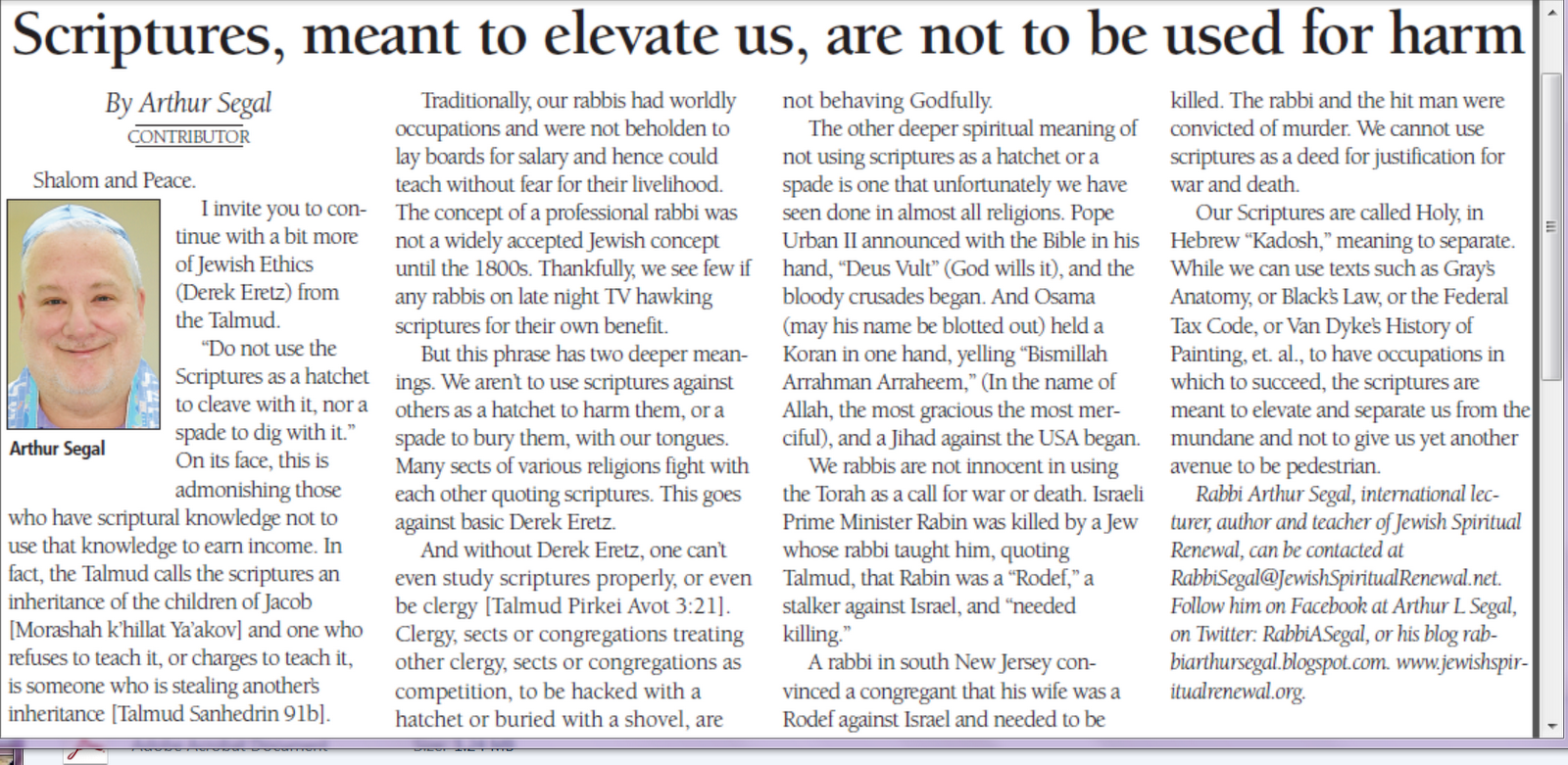
I invite you to continue with a bit more of Jewish Ethics (Derek Eretz) from the Talmud.

''Do not use the Scriptures as a hatchet to cleave with it, nor a spade to dig with it.'' On its face this is admonishing those who have Scriptural knowledge not to use that knowledge to earn income. In fact, the Talmud calls the Scriptures an inheritance of the children of Jacob, [ Morashah k'hillat Ya'akov], and one who refuses to teach it, or charges to teach it, is someone who is stealing another's inheritance [ Talmud Sanhedrin 91b].


Traditionally our rabbis had worldly occupations and were not beholden to lay boards for salary, and hence could teach without fear for their livelihood. The concept of a professional rabbi was not a widely accepted Jewish concept until the 1800s.   Thankfully, we see few if any rabbis on late night TV hawking Scriptures for their own benefit.


But this phrase has two deeper meanings. We aren't to use Scriptures against others as a hatchet to harm them, or a spade to bury them, with our tongues. Many sects of various religions fight with each other quoting Scriptures.  This goes against basic Derek Eretz. And without Derek Eretz, one can't even study Scriptures properly, or even be clergy {Talmud Pirkei Avot 3:21}. Clergy, sects or congregations, treating other clergy, sects or congregations, as competition to be hacked with a hatchet or buried with a shovel, are not behaving Godfully.


The other deeper spiritual meaning of not using Scriptures as a hatchet or a spade is one that unfortunately we have seen done in almost all religions. Pope Urban II announced with the Bible in his hand, ''Deus Vult'', (God wills it), and the bloody crusades began. And Osama (may his name be blotted out) held a Koran in one hand, yelling ''Bismillah Arrahman Arraheem'', (In the name of Allah, the most gracious the most merciful), and a Jihad against the USA begins.


We Rabbis are not innocent in using the Torah as a call for war or death. Israeli Prime Minister Rabin was killed by a Jew, whose Rabbi taught him, quoting Talmud, that Rabin was a '' Rodef '', a stalker against Israel and ''needed killing.'' A rabbi in south N.J. convinced a congregant that his wife was a Rodef against Israel and needed to be killed.  The rabbi and the hit man were convicted of murder.  We cannot use Scriptures as a deed for justification for war and death.


Our Scriptures are called Holy, in Hebrew ''Kadosh'', meaning to separate.  While we can use texts such as Gray's Anatomy, or Black's Law, or the Federal Tax Code, or Van Dyke's History of Painting et. al. to have occupations in which to succeed, the Scriptures are meant to elevate and separate us from the mundane and not to give us yet another avenue to be pedestrian.

Rabbi Arthur Segal is an international lecturer, author, and teacher. Visit him at www.JewishSpiritualRenewal.org .   Follow him on FaceBook at 'Arthur L Segal', on Twitter at RabbiASegal, or his blog at  http://rabbiarthursegal.blogspot.com  .  Email at RabbiSegal@JewishSpiritualRenewal.net


RABBI ARTHUR SEGAL:JEWISH RENEWAL: SCRIPTURES TO ELEVATE, NOT HARM:DEREK ERETZ


RABBI ARTHUR SEGAL: SCRIPTURES USED TO ELEVATE , NOT HARM US; DEREK ERETZ


Shalom and Peace:


I invite you to continue with a bit more of Jewish Ethics (Derek Eretz) from the Talmud.

''Do not use the Scriptures as a hatchet to cleave with it, nor a spade to dig with it.'' On its face this is admonishing those who have Scriptural knowledge not to use that knowledge to earn income. In fact, the Talmud calls the Scriptures an inheritance of the children of Jacob, [ Morashah k'hillat Ya'akov], and one who refuses to teach it, or charges to teach it, is someone who is stealing another's inheritance [ Talmud Sanhedrin 91b].


Traditionally our rabbis had worldly occupations and were not beholden to lay boards for salary, and hence could teach without fear for their livelihood. The concept of a professional rabbi was not a widely accepted Jewish concept until the 1800s.   Thankfully, we see few if any rabbis on late night TV hawking Scriptures for their own benefit.


But this phrase has two deeper meanings. We aren't to use Scriptures against others as a hatchet to harm them, or a spade to bury them, with our tongues. Many sects of various religions fight with each other quoting Scriptures.  This goes against basic Derek Eretz. And without Derek Eretz, one can't even study Scriptures properly, or even be clergy {Talmud Pirkei Avot 3:21}. Clergy, sects or congregations, treating other clergy, sects or congregations, as competition to be hacked with a hatchet or buried with a shovel, are not behaving Godfully.


The other deeper spiritual meaning of not using Scriptures as a hatchet or a spade is one that unfortunately we have seen done in almost all religions. Pope Urban II announced with the Bible in his hand, ''Deus Vult'', (God wills it), and the bloody crusades began. And Osama (may his name be blotted out) held a Koran in one hand, yelling ''Bismillah Arrahman Arraheem'', (In the name of Allah, the most gracious the most merciful), and a Jihad against the USA begins.


We Rabbis are not innocent in using the Torah as a call for war or death. Israeli Prime Minister Rabin was killed by a Jew, whose Rabbi taught him, quoting Talmud, that Rabin was a '' Rodef '', a stalker against Israel and ''needed killing.'' A rabbi in south N.J. convinced a congregant that his wife was a Rodef against Israel and needed to be killed.  The rabbi and the hit man were convicted of murder.  We cannot use Scriptures as a deed for justification for war and death.


Our Scriptures are called Holy, in Hebrew ''Kadosh'', meaning to separate.  While we can use texts such as Gray's Anatomy, or Black's Law, or the Federal Tax Code, or Van Dyke's History of Painting et. al. to have occupations in which to succeed, the Scriptures are meant to elevate and separate us from the mundane and not to give us yet another avenue to be pedestrian.

Rabbi Arthur Segal is an international lecturer, author, and teacher. Visit him at www.JewishSpiritualRenewal.org .   Follow him on FaceBook at 'Arthur L Segal', on Twitter at RabbiASegal, or his blog at  http://rabbiarthursegal.blogspot.com  .  Email at RabbiSegal@JewishSpiritualRenewal.net


RABBI ARTHUR SEGAL:JEWISH SPIRITUALITY: SCRIPTURES TO ELEVATE, NOT HARM


RABBI ARTHUR SEGAL: JEWISH SPIRITUALITY  ; SCRIPTURES USED TO ELEVATE , NOT HARM US


Shalom and Peace:


I invite you to continue with a bit more of Jewish Ethics (Derek Eretz) from the Talmud.

''Do not use the Scriptures as a hatchet to cleave with it, nor a spade to dig with it.'' On its face this is admonishing those who have Scriptural knowledge not to use that knowledge to earn income. In fact, the Talmud calls the Scriptures an inheritance of the children of Jacob, [ Morashah k'hillat Ya'akov], and one who refuses to teach it, or charges to teach it, is someone who is stealing another's inheritance [ Talmud Sanhedrin 91b].


Traditionally our rabbis had worldly occupations and were not beholden to lay boards for salary, and hence could teach without fear for their livelihood. The concept of a professional rabbi was not a widely accepted Jewish concept until the 1800s.   Thankfully, we see few if any rabbis on late night TV hawking Scriptures for their own benefit.


But this phrase has two deeper meanings. We aren't to use Scriptures against others as a hatchet to harm them, or a spade to bury them, with our tongues. Many sects of various religions fight with each other quoting Scriptures.  This goes against basic Derek Eretz. And without Derek Eretz, one can't even study Scriptures properly, or even be clergy {Talmud Pirkei Avot 3:21}. Clergy, sects or congregations, treating other clergy, sects or congregations, as competition to be hacked with a hatchet or buried with a shovel, are not behaving Godfully.


The other deeper spiritual meaning of not using Scriptures as a hatchet or a spade is one that unfortunately we have seen done in almost all religions. Pope Urban II announced with the Bible in his hand, ''Deus Vult'', (God wills it), and the bloody crusades began. And Osama (may his name be blotted out) held a Koran in one hand, yelling ''Bismillah Arrahman Arraheem'', (In the name of Allah, the most gracious the most merciful), and a Jihad against the USA begins.


We Rabbis are not innocent in using the Torah as a call for war or death. Israeli Prime Minister Rabin was killed by a Jew, whose Rabbi taught him, quoting Talmud, that Rabin was a '' Rodef '', a stalker against Israel and ''needed killing.'' A rabbi in south N.J. convinced a congregant that his wife was a Rodef against Israel and needed to be killed.  The rabbi and the hit man were convicted of murder.  We cannot use Scriptures as a deed for justification for war and death.


Our Scriptures are called Holy, in Hebrew ''Kadosh'', meaning to separate.  While we can use texts such as Gray's Anatomy, or Black's Law, or the Federal Tax Code, or Van Dyke's History of Painting et. al. to have occupations in which to succeed, the Scriptures are meant to elevate and separate us from the mundane and not to give us yet another avenue to be pedestrian.

Rabbi Arthur Segal is an international lecturer, author, and teacher. Visit him at www.JewishSpiritualRenewal.org .   Follow him on FaceBook at 'Arthur L Segal', on Twitter at RabbiASegal, or his blog at  http://rabbiarthursegal.blogspot.com  .  Email at RabbiSegal@JewishSpiritualRenewal.net


=

RABBI ARTHUR SEGAL:ECO-JUDAISM: SCRIPTURES TO ELEVATE, NOT HARM ;DEREK ERETZ


RABBI ARTHUR SEGAL:ECO-JUDAISM: SCRIPTURES TO ELEVATE, NOT HARM ;DEREK ERETZ 


Shalom and Peace:


I invite you to continue with a bit more of Jewish Ethics (Derek Eretz) from the Talmud.

''Do not use the Scriptures as a hatchet to cleave with it, nor a spade to dig with it.'' On its face this is admonishing those who have Scriptural knowledge not to use that knowledge to earn income. In fact, the Talmud calls the Scriptures an inheritance of the children of Jacob, [ Morashah k'hillat Ya'akov], and one who refuses to teach it, or charges to teach it, is someone who is stealing another's inheritance [ Talmud Sanhedrin 91b].


Traditionally our rabbis had worldly occupations and were not beholden to lay boards for salary, and hence could teach without fear for their livelihood. The concept of a professional rabbi was not a widely accepted Jewish concept until the 1800s.   Thankfully, we see few if any rabbis on late night TV hawking Scriptures for their own benefit.


But this phrase has two deeper meanings. We aren't to use Scriptures against others as a hatchet to harm them, or a spade to bury them, with our tongues. Many sects of various religions fight with each other quoting Scriptures.  This goes against basic Derek Eretz. And without Derek Eretz, one can't even study Scriptures properly, or even be clergy {Talmud Pirkei Avot 3:21}. Clergy, sects or congregations, treating other clergy, sects or congregations, as competition to be hacked with a hatchet or buried with a shovel, are not behaving Godfully.


The other deeper spiritual meaning of not using Scriptures as a hatchet or a spade is one that unfortunately we have seen done in almost all religions. Pope Urban II announced with the Bible in his hand, ''Deus Vult'', (God wills it), and the bloody crusades began. And Osama (may his name be blotted out) held a Koran in one hand, yelling ''Bismillah Arrahman Arraheem'', (In the name of Allah, the most gracious the most merciful), and a Jihad against the USA begins.


We Rabbis are not innocent in using the Torah as a call for war or death. Israeli Prime Minister Rabin was killed by a Jew, whose Rabbi taught him, quoting Talmud, that Rabin was a '' Rodef '', a stalker against Israel and ''needed killing.'' A rabbi in south N.J. convinced a congregant that his wife was a Rodef against Israel and needed to be killed.  The rabbi and the hit man were convicted of murder.  We cannot use Scriptures as a deed for justification for war and death.


Our Scriptures are called Holy, in Hebrew ''Kadosh'', meaning to separate.  While we can use texts such as Gray's Anatomy, or Black's Law, or the Federal Tax Code, or Van Dyke's History of Painting et. al. to have occupations in which to succeed, the Scriptures are meant to elevate and separate us from the mundane and not to give us yet another avenue to be pedestrian.

Rabbi Arthur Segal is an international lecturer, author, and teacher. Visit him at www.JewishSpiritualRenewal.org .   Follow him on FaceBook at 'Arthur L Segal', on Twitter at RabbiASegal, or his blog at  http://rabbiarthursegal.blogspot.com  .  Email at RabbiSegal@JewishSpiritualRenewal.net


RABBI ARTHUR SEGAL: BLUFFTON, SC SUN: SEPTEMBER 2011: BIBLE USED TO ELEVATE


RABBI ARTHUR SEGAL: BLUFFTON, SC SUN: SEPTEMBER 2011: BIBLE USED TO ELEVATE


Shalom and Peace:


I invite you to continue with a bit more of Jewish Ethics (Derek Eretz) from the Talmud.

''Do not use the Scriptures as a hatchet to cleave with it, nor a spade to dig with it.'' On its face this is admonishing those who have Scriptural knowledge not to use that knowledge to earn income. In fact, the Talmud calls the Scriptures an inheritance of the children of Jacob, [ Morashah k'hillat Ya'akov], and one who refuses to teach it, or charges to teach it, is someone who is stealing another's inheritance [ Talmud Sanhedrin 91b].


Traditionally our rabbis had worldly occupations and were not beholden to lay boards for salary, and hence could teach without fear for their livelihood. The concept of a professional rabbi was not a widely accepted Jewish concept until the 1800s.   Thankfully, we see few if any rabbis on late night TV hawking Scriptures for their own benefit.


But this phrase has two deeper meanings. We aren't to use Scriptures against others as a hatchet to harm them, or a spade to bury them, with our tongues. Many sects of various religions fight with each other quoting Scriptures.  This goes against basic Derek Eretz. And without Derek Eretz, one can't even study Scriptures properly, or even be clergy {Talmud Pirkei Avot 3:21}. Clergy, sects or congregations, treating other clergy, sects or congregations, as competition to be hacked with a hatchet or buried with a shovel, are not behaving Godfully.


The other deeper spiritual meaning of not using Scriptures as a hatchet or a spade is one that unfortunately we have seen done in almost all religions. Pope Urban II announced with the Bible in his hand, ''Deus Vult'', (God wills it), and the bloody crusades began. And Osama (may his name be blotted out) held a Koran in one hand, yelling ''Bismillah Arrahman Arraheem'', (In the name of Allah, the most gracious the most merciful), and a Jihad against the USA begins.


We Rabbis are not innocent in using the Torah as a call for war or death. Israeli Prime Minister Rabin was killed by a Jew, whose Rabbi taught him, quoting Talmud, that Rabin was a '' Rodef '', a stalker against Israel and ''needed killing.'' A rabbi in south N.J. convinced a congregant that his wife was a Rodef against Israel and needed to be killed.  The rabbi and the hit man were convicted of murder.  We cannot use Scriptures as a deed for justification for war and death.


Our Scriptures are called Holy, in Hebrew ''Kadosh'', meaning to separate.  While we can use texts such as Gray's Anatomy, or Black's Law, or the Federal Tax Code, or Van Dyke's History of Painting et. al. to have occupations in which to succeed, the Scriptures are meant to elevate and separate us from the mundane and not to give us yet another avenue to be pedestrian.

Rabbi Arthur Segal is an international lecturer, author, and teacher. Visit him at www.JewishSpiritualRenewal.org .   Follow him on FaceBook at 'Arthur L Segal', on Twitter at RabbiASegal, or his blog at  http://rabbiarthursegal.blogspot.com  .  Email at RabbiSegal@JewishSpiritualRenewal.net


Sunday, October 30, 2011

RABBI ARTHUR SEGAL: ECO-JUDAISM :LECH LECHA: CHOICE AND JUDAISM :ETHICS :MUSSAR

  RABBI ARTHUR SEGAL: ECO-JUDAISM :LECH LECHA: CHOICE AND JUDAISM :ETHICS :MUSSAR
 
 
RABBI ARTHUR SEGAL:  CHUMASH CANDESCENCE: PARASHA LECH LECHA:
GENESIS 12:01-17:27


CHUMASH CANDESCENCE
PARASHA LECH LECHA
GENESIS 12:01-17:27
RABBI ARTHUR  SEGAL

Rabbi Arthur Segal_  www.jewishspiritualrenewal.org_

(http://www.jewishspiritualrenewal.org/ ) 

Via Shamash Org  on-line class service

Jewish Renewal_  www.jewishrenewal.info _ (http://www.jewishrenewal.info/ ) 

Jewish Spiritual  Renewal

Jewish Spirituality

Eco Judaism

Hilton Head Island, SC,  Bluffton, SC, Savannah,  GA


"Goin' to A Go-Go"

SYNOPTIC ABSTRACT:
Our parasha continues with the tales of Abraham, the father of the Hebrew people. This portion relates God's call to Abraham, his journey to Canaan, his trip with Sarah to Egypt, his return to Canaan and his nephew Lot's parting, Lot being taken captive and Abraham's rescue of Lot, God's covenant with Abraham, the birth of Hagar's son Ishmael, the commandment of circumcision, and God's promise to ninety-year old Sarah that she will
give birth to a child with her 100-year old husband, Abraham. This is the parasha that begins it all as far as Jews are concerned. Here are the seeds of the present day Arab-Jew land dispute. To read all about it; "Lech Lecha!" (Go on for yourself!).

Our parasha's title takes its name from God's command to Abraham. "Lech Lecha!--Go for yourself!" This sums up the choice that each of us has with our birthright of Judaism. As adults, no one is forcing Judaism upon us. No one is forcing us to live an ethical life. No one even is demanding that we study Torah or read these or other D'varim. We have freedom of choice. We decide, for ourselves, to go or to do, or not to go
or not to do. This is no different than the choice that Abraham had to make 3500 or so years ago.

The story of Abraham is the story of his trials. Mishna Pirkei Avot (5:3) says that "our patriarch Abraham was tested with ten tests and he withstood them all to show how great was our Patriarch Abraham's love for God." What were these ten tests?

1. In Ur, King Nimrod threw Abraham into a fiery furnace when his father, Terach, complained about his destroying the idols (Gen. 11:26). If you turn to this verse in last week's portion you will see no mention of this. The Talmudic sages are quoting the Midrash story of how little Abraham broke his father's idol. The Midrash says his father was an idol maker.
2. He had to leave his homeland to settle in Canaan (Gen. 12:01).
3. He had to move from Canaan to Egypt due to famine (Gen. 12:10).
4. Sarah, his wife, was taken to Pharaoh's palace as a potential wife of Pharaoh. Abraham asked Sarah to call herself Abraham's sister to spare his life. The sages say that this was not a lie, as Sarah was Haran's daughter. Haran was Abraham's brother. Therefore, Sarah was Abraham's niece, which the sages say is close enough to be called a sister.


But the Torah says that Haran had two daughters. They were Milcah and Iscah. And Milcha married Nahor, Abraham's other brother. "Aha!", the sages say. Iscah is just another name for Sarah. The potential problem of our father Abraham lying to save himself and passing off his wife as a virgin sister is solved.
5. The war with the kings to free his nephew Lot (Gen. 14:01-24).
6. The covenant where Abraham was told of his children being promised the land of Canaan, but also of being enslaved and going into exile (Gen15:7-21).
7. Abraham undergoing self-circumcision at the age of ninety-nine years (Gen. 17:24).
8. Expelling his wife Hagar from his home (Gen. 21:10-14).
9. Expelling his son Ishmael from his home (Gen. 21:10-14).
10. And the Akeidah--the binding of Abraham's son Isaac to be a
sacrificial offering to God (Gen. 22:1-19).

How would we fare if we had these tests today? Do any of our life's tests compare to these?

The Mishna calls these tests "neis." The Hebrew word for "tests" is "bechinah." "Neis" is also a "banner." It is used in Psalm 60:6, "You gave those who fear a banner to raise themselves." The sages say a banner is something which is raised high to show its beauty. When we pass some of life's tests, we are lifted into a higher sphere so that we can go on to bigger tests. This is why we say "yasher koach" after a bimah honor. We wish people to "go from strength to strength." The Mishna's passage
could be read "And God exalted Abraham" instead of "God tested Abraham."

The last three of these ten tests take place in next week's parasha and will be discussed then. Nachmanides (the Ramban) comments on the second test; that of leaving one's home and known surroundings to search for a better life. I think of all of our grandparents, great-grandparents, or those even farther back, who left their homes in Europe to resettle here in the United States of America.  The only emotions that come to me, as a soft, third generation American-Jew, is great alarm and fear, until I learned to have  a personal trusting and faithful relationship

with God.

Ramban says that one never is given trials that he cannot deal with effectively. He says a person has free choice and he must find the wisdom and strength to choose correctly. If he chooses correctly, he grows as a person. He is not rewarded by Heaven for his successes. His reward is his successes. As the parasha's title suggests, we do good things for "ourselves", and because it is the right choice to make. We do not do good in hope of reward from "above."

What does it mean to be a Jew? We have a hint of this complex answer in verse 14:13 in Genesis. For the first time, Abraham is called an "Ivri." Some Torah scholars say this refers to Abraham being descended from Eber. Eber was six generations removed from Abraham. Would a fugitive from a battle in Sodom coming to tell Abraham that his nephew Lot was taken prisoner know Abraham's lineage this closely, especially when they were
then in Canaan and Eber and his kin lived in what is now Iraq? There are very few of us that can name our ancestors, six-times removed, and there are still fewer strangers that can do so.

Abraham indeed was an Ivri. The word is derived from "Ivar" meaning "the other side." Literally, Abraham did come from the other side of the Euphrates River. Our Talmudic rabbis interpret it much differently. Abraham was on one side of a moral and spiritual divide, according to rabbi Nosson Scherman. The rest of the known world was on the other side. Jews must be ready to endure isolation sometimes when we stand up for what is morally right, even when our voices seem small and unimportant.
It is pleasant to be popular and win the approval of others. Too often we bend our own principles in order not to "make waves." Abraham and Sarah, rabbi Scherman continues, were given the challenge to be Ivri, and move to the other side.

When God appeared to Abraham, renamed him from his old name of "Avram", and gave him the commandment of circumcision, He called Himself "El Shaddai" (Gen. 17:01). This name of God means "Who is sufficient." As Jews we need to realize that we can do without popularity if it means
standing up for justice and ethics. It is interesting that God called
Himself "sufficient" at the time He ordered brit milah (the covenant of circumcision). The brit is a symbol that we can do "without" sometimes and that less can be more than sufficient if we stand up for what is right and just, even if it puts us on the "other side". Perhaps this is a good definition of what it means to be Jewish, and a descendant of Abraham, the first Ivri and the first Hebrew.

Shabbat Shalom,
Rabbi Arthur  Segal,


Rabbi Arthur Segal_  www.jewishspiritualrenewal.org_

(http://www.jewishspiritualrenewal.org/ ) 

Via Shamash Org  on-line class service

Jewish Renewal_  www.jewishrenewal.info _ (http://www.jewishrenewal.info/ ) 

Jewish Spiritual  Renewal

Jewish Spirituality

Eco Judaism

Hilton Head Island, SC,  Bluffton, SC, Savannah,  GA


If  visiting SC's Low Country, contact us for a Shabbat meal, in our home

by the  sea, our beth  yam.


Maker  of Shalom (Oseh Shalom) help make us deserving of Shalom beyond all

human  comprehension! 


The JEWISH SPIRITUAL RENEWAL  mailing list is hosted by _Shamash:  The

Jewish Network_ (http://shamash.org/ ) .